
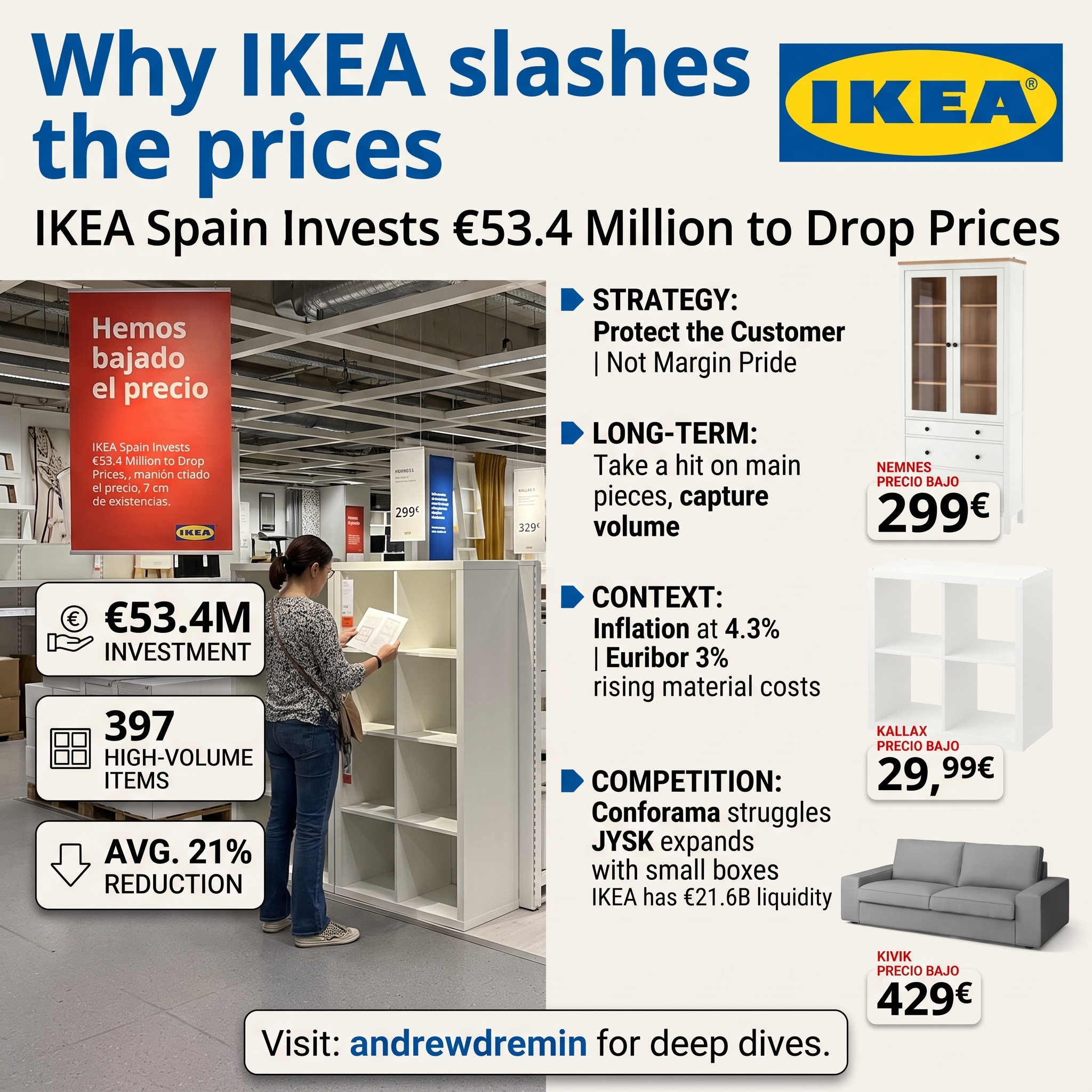
€53.4 million. That is the cash IKEA is reportedly putting on the table in Spain right now to slash prices on 397 high-volume items by an average of 21%. This aggressive move highlights a deliberate IKEA Spain pricing strategy aimed at market dominance.
Most retail executives view this move as irrational. Spanish inflation reached 4.3% in August. The Euribor is hovering near 3%, which drives up borrowing costs for everyone. Factory material costs are rising steadily across Europe. Yet, in the middle of this economic squeeze, IKEA chooses to cut prices on core items like Kallax shelves and Kivik sofas.
The basic hypothesis here is that when households bleed cash, a retailer should not protect its margin. It must protect its customer base. The logic is sound, but it requires deep pockets and ruthless execution. Let us test the mechanics of this move to understand if it is a sustainable strategy or a temporary market distortion.
IKEA Pricing Strategy: Bleeding Margins to Buy Market Share
When inflation hits, the standard corporate reflex is to pass the cost down to the consumer. Supply chains become expensive, transport costs rise, and executive boards demand that margin percentages remain stable.
IKEA is doing the exact opposite. Assuming the €53.4 million figure is an accurate baseline metric for their current Spanish operations, this is a calculated investment in customer acquisition. They are leveraging massive scale to absorb the inflation shock entirely.
Consider the average consumer. We can call him Carlos, living in Madrid. His mortgage reset just added roughly €800 to his yearly expenses. His disposable income is shrinking fast. When his child needs a new bed, Carlos becomes highly price-sensitive.
He will not spend €600 at a competitor like Maisons du Monde. That specific chain is dealing with high overhead and recently had to renegotiate rents across all its 34 Spanish stores just to manage costs. Instead, Carlos goes straight to IKEA. He does this because the price gap is now too large to ignore.
This strategy is not charity. It is predatory market consolidation. IKEA is using its cash reserves to apply immense pressure on weaker competitors, forcing them into a corner.
Why Retail Market Consolidation in Spain is Accelerating
Look at the current playing field in the Spanish furniture market. The data points indicate severe structural weakness among IKEA’s primary rivals:
- Conforama: Reported to have lost almost €100 million in Spain over a four-year period. They are fighting simply to keep their operations viable and their supply chains funded.
- Maisons du Monde: Struggling with premium positioning. When the middle class loses purchasing power, high-margin decorative furniture is the first category consumers abandon.
- JYSK: Pushing hard with an aggressive expansion plan of 120 stores across the Iberian peninsula. However, they operate primarily in small-box formats. This limits their inventory depth and prevents them from offering the massive experiential retail advantage that a full-size warehouse provides.
IKEA knows these competitors are vulnerable right now. By cutting prices on nearly 400 highly visible items, they force these rivals into an impossible choice: drop prices and risk bankruptcy, or keep prices high and lose all foot traffic.
How Liquid Assets Fund a Long-Term Furniture Retail Strategy
The core reason IKEA can execute this price cut lies in its corporate structure.
IKEA holds massive liquid assets – reported at €21.6 billion globally. This demonstrates significant IKEA financial strength. More importantly, it answers to an unlisted foundation, the INGKA Foundation. It does not answer to impatient Wall Street analysts or institutional shareholders who demand quarterly profit growth.
This structural setup provides a massive tactical advantage. Publicly traded retail chains are punished heavily by the stock market if their gross margins drop for even a single quarter. Private entities like IKEA can intentionally operate at a lower margin for years to starve out the competition.
This is not an isolated experiment limited to Spain. The same playbook is active across Europe:
- In Germany, prices were dropped on over 1,500 items.
- In the UK market, the price of the iconic Billy bookcase was cut by 28%.
The geographical spread of these cuts proves this is a centralized, deliberate tactic to exploit the current European economic downturn.
Overcoming Supply Chain Pressures
To understand how they fund this internally, we must look at factory material costs. Lumber, steel, and shipping containers have seen violent price swings. Mid-tier furniture retailers pass these costs directly to the shelf price because they lack cash buffers.
IKEA controls massive swathes of its own supply chain, from raw timber sourcing to proprietary flat-pack logistics. They do not just lower prices blindly. They optimize the shipping volume of a cardboard box by a few millimeters to save millions in global freight, effectively subsidizing the price cut at the retail shelf.
The Cross-Selling Engine: High-Margin Furniture Accessories
The actual profit mechanism requires critical analysis. A company cannot survive purely by selling large furniture at a loss. The math only works through aggressive, systematic cross-selling.
IKEA takes a deliberate hit on the main furniture piece. They might sell a sofa at near cost. But when a customer like Carlos walks into that warehouse, the physical store layout forces him through a maze of secondary products.
He walks out with the bed, but he also puts the following in his cart:
- Throw pillows
- LED desk lamps
- Plastic storage boxes
- Picture frames
- Kitchen utensils
While the main furniture piece acts as the traffic driver, these accessories carry massive markups. The stated 60% margin on these smaller items is a realistic retail benchmark for unbranded, high-volume plastics and textiles (though exact category margins remain proprietary and require independent verification).
The blended margin of the total shopping cart remains profitable. IKEA sacrifices the unit profit of the anchor item to guarantee the foot traffic necessary to sell the high-margin accessories.
Volume Over Margin: The Brutal Survival Rule
This brings us to the core thesis of modern retail survival. If your shoppers are hurting economically, and you raise prices solely to defend your margin percentage, you are making a fatal error. You give away your market share to whoever can bleed cash longer than you.
There is a cognitive bias among retail executives to protect the perceived value of their brand by refusing to discount. They suffer from a principal-agent problem: a CEO is incentivized by short-term metrics to secure their annual bonus. Taking a margin hit destroys those metrics. But the market does not care about executive bonuses or brand pride when the Euribor is at 3% and basic living costs are spiking. The market cares about utility and affordability.
Margin pride kills retail businesses during a recession. Volume keeps the lights on. Cash flow pays the rent, pays the warehouse staff, and clears the aging inventory. A high margin percentage on a product that sits in a distribution center for six months is entirely useless.
In three to five years, when inflation normalizes and weaker competitors have either shrunk or exited the market, IKEA will own the consolidated IKEA market share. Once the competition is dead, they will possess the pricing power to slowly raise rates again.
If you are running category margins right now, test your own strategy against this reality: are you sacrificing unit profit to protect foot traffic, or are you defending your margin percentage and risking volume?
FAQ
Why is IKEA lowering prices while general inflation is high?
IKEA uses price cuts as a customer acquisition tool during economic downturns. While competitors raise prices to cover rising supply chain costs, IKEA absorbs the hit using its large cash reserves. This builds long-term customer loyalty and captures market share from struggling rivals.
How does IKEA afford a €53.4 million price cut in Spain?
IKEA is backed by an unlisted foundation and holds roughly €21.6 billion in global liquid assets. Because they do not have to report quarterly profit growth to public shareholders, they can afford to take short-term margin losses to achieve long-term strategic dominance.
What is the loss-leader strategy in furniture retail?
A loss-leader strategy involves selling a high-profile item (like a bed or shelf) at or below cost to drive foot traffic into the store. The retailer then makes its profit by cross-selling smaller, high-margin accessories (like pillows, lamps, and storage boxes) to the same customer.
How does a 3% Euribor affect retail sales in Spain?
The Euribor dictates the interest rates for most variable mortgages in Spain. When it rises to near 3%, monthly mortgage payments increase significantly, stripping households of hundreds of euros in disposable income. This makes consumers highly price-sensitive and reduces overall retail spending.


Leave a Reply