
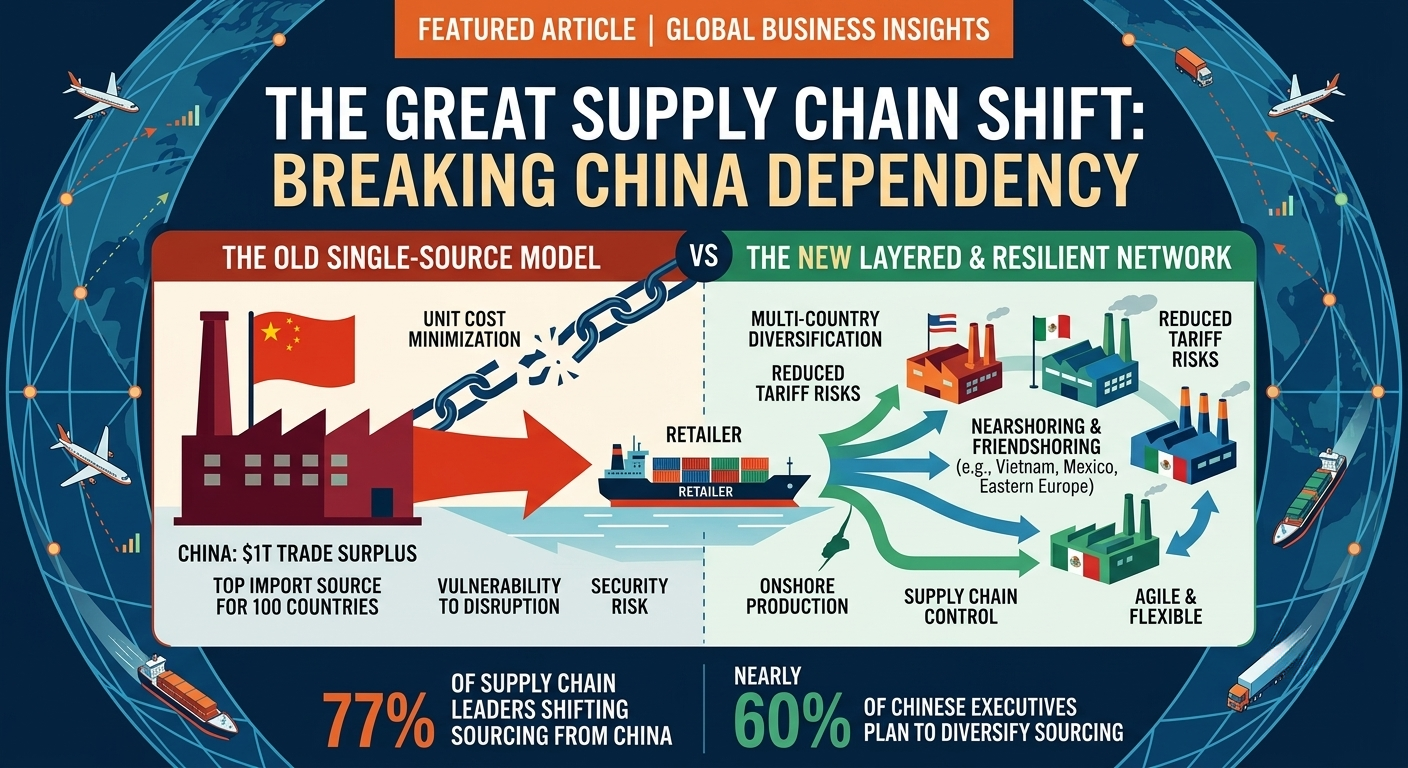
China holds a $1 trillion trade surplus with the rest of the world. It is the primary source of imports for 100 countries. Looking ahead, retail supply chain sourcing trends 2026 are likely to be shaped by China’s dominant position. To put that in perspective, the U.S. is the top import source for 33 countries, and Germany holds that spot for 20.
For thirty years, global business relied on a simple formula: find the lowest unit cost in China, sign the purchase order, and import the goods. Retailers and FMCG (Fast-Moving Consumer Goods) companies treated this setup as a permanent bargain. Consumers got cheap products, and companies protected their profit margins.

Infographic source: Visual Capitalist
That era is over. Buying goods purely based on the lowest factory-gate price is now a major business and operational risk.
The 2026 Sourcing Shift: Data and Numbers
The global supply chain landscape is shifting rapidly. Retailers no longer care only about low manufacturing costs. They want operational control, predictable delivery times, and lower political risk.
Industry data highlights two major structural changes happening right now:
- Western buyers are reducing single-country reliance: 77% of supply chain leaders are currently shifting sourcing away from China toward tariff-neutral countries.
- Chinese manufacturers are nearshoring themselves: Nearly 60% of Chinese supply chain executives plan to diversify their production footprints this year. They are building factories in Southeast Asia, Mexico, and Eastern Europe to lower tariff risks and stay close to end customers.
When both the buyer and the manufacturer move in the same direction, it shows that the single-source production model no longer works.
Why Traditional Trade Logic Is Failing
Standard trade theory assumes that free trade works best when every nation focuses on what it makes cheapest. This idea of comparative advantage works well in textbooks, but it fails in real-world operations for three reasons:
- Geopolitical Concentration Risk: Free trade requires stable, neutral shipping routes. When one single state controls the baseline manufacturing for 100 nations, trade becomes vulnerable to political friction and policy shifts.
- Hidden Total Cost of Ownership (TCO): Low unit price does not mean low total cost. Shipping goods across the ocean ties up working capital for 30 to 45 days. When you add shipping delays, freight rate spikes, and tariffs, the true cost per unit rises significantly.
- Single Point of Failure (SPOF): If a factory or port in one region shuts down, your entire supply chain stops. You cannot replace 100% of your stock on short notice.
Sourcing Model Comparison: Unit-Cost vs. Resilient
| Factor | Old Model (Unit-Cost Driven) | New Model (Resilient Sourcing) |
| Primary Goal | Lowest landed unit price | High supply security and speed |
| Network Layout | Single region / Single country | Layered multi-region network |
| Delivery Lead Time | 30 to 60 days | 7 to 21 days (nearshore/onshore) |
| Tariff Exposure | High | Low to moderate |
| Working Capital | Tied up in long transit times | Lower inventory buffer required |
The 3-Tier Layered Sourcing Framework for Retail & FMCG
Relying on a single country for your inventory is poor risk management. Modern retail and FMCG companies need a structured, three-tier supply network to balance cost and security.
Tier 1: Base Volume (Offshore)
- Allocation: 50% to 60% of total volume.
- Purpose: High-volume, standard products with predictable demand and long shelf lives.
- Location: Primary Asian manufacturing hubs.
- Objective: Achieve high economies of scale and maintain baseline cost efficiency.
Tier 2: Flexible Capacity (Nearshore)
- Allocation: 25% to 35% of total volume.
- Purpose: Seasonal items, unexpected demand spikes, and quick inventory restocks.
- Location: Tariff-neutral regions close to major consumer markets (e.g., Mexico for North America; Türkiye or Poland for Europe; Vietnam for Asia-Pacific).
- Objective: Fast turnaround times (1 to 2 weeks) and reduced tariff exposure.
Tier 3: Rapid Buffer (Onshore)
- Allocation: 10% to 15% of total volume.
- Purpose: Emergency restocks, high-margin items, and small batches for market testing.
- Location: Local domestic producers.
- Objective: Maximum operational agility, zero international transit lag, and zero border friction.
Action Plan for Supply Chain Leaders
To protect your business from supply shocks and policy changes, implement these four practical steps:
- Map single-country dependencies: Identify every SKU that relies on a single country for more than 60% of its finished volume or raw materials.
- Calculate true TCO: Stop comparing factory gate quotes alone. Factor in working capital costs, ocean freight uncertainty, tariff rates, and the cost of lost sales from out-of-stock items.
- Qualify secondary suppliers early: Onboarding a new factory in Mexico, Vietnam, or Eastern Europe takes 6 to 9 months. Do not wait for a supply line failure to start this process.
- Set internal sourcing limits: Create a corporate rule that no single country can supply more than 50% of your critical product inventory.
Setting up a resilient, layered network requires higher initial setup costs and slightly higher average unit prices. However, running out of inventory costs far more over time. Supply chain management in 2026 is no longer about finding the cheapest factory – it is about keeping your supply chain moving when trade routes break.


Leave a Reply