
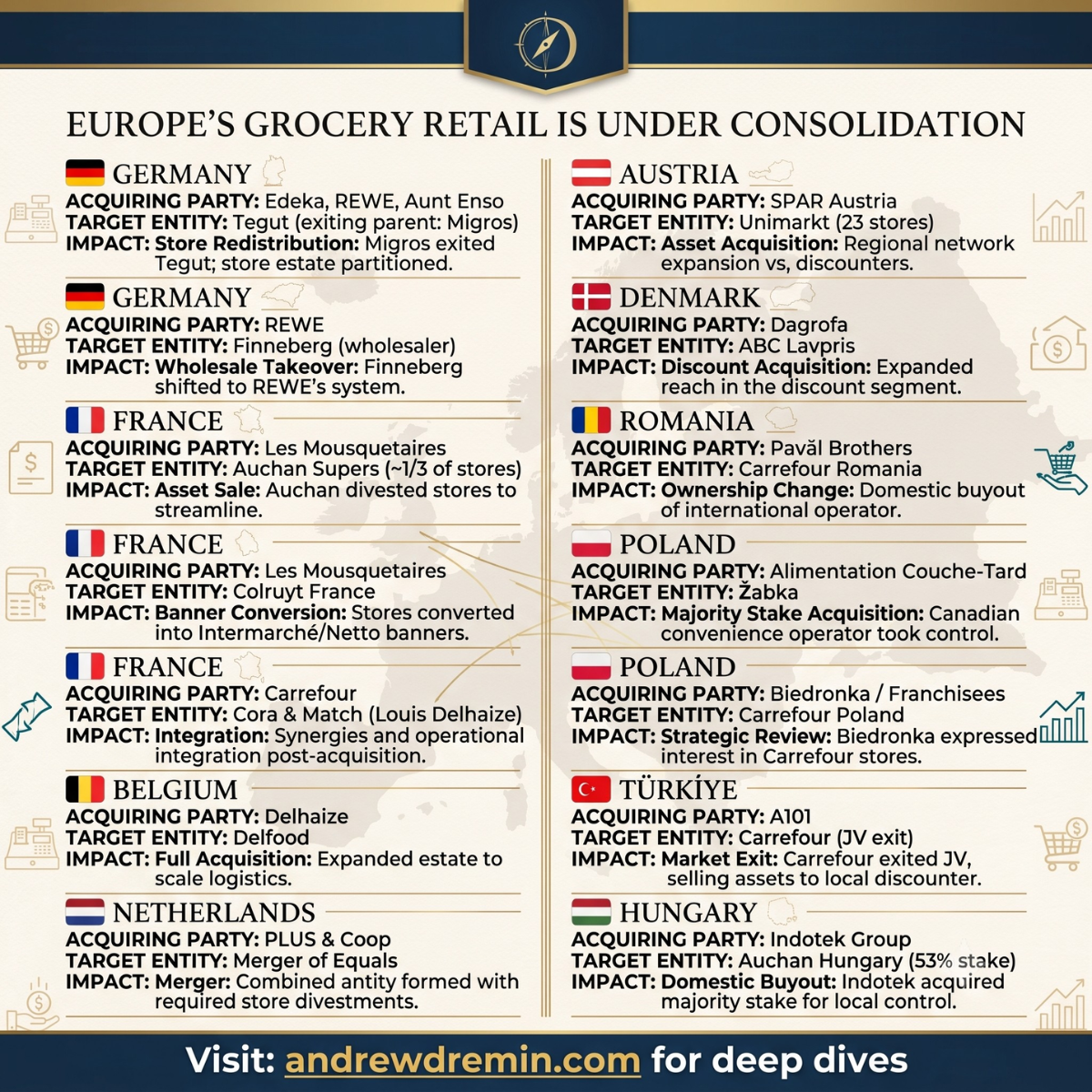
M&A deals in European grocery retail are up 30% since 2020, reflecting a broader movement toward Europe grocery retail consolidation 2026 is expected to accelerate. Corporate presentations call this trend “strategic scale” and “portfolio optimization.” The real reason is simpler: organic volume growth in European grocery retail is dead.
Population growth across key European markets is flat. Inflation has eroded real consumer buying power, forcing shoppers to cut volume per basket. Opening new physical stores does not drive profit anymore. Real estate costs are high, construction costs have surged, and local markets are fully saturated. Adding physical square meters today often leads to cannibalization of a retailer’s existing stores rather than new revenue.
Because grocers cannot grow by building new locations, they grow by buying competitors.
Why Grocers Buy Competitors: The Operational Shield
Retailers buy competitors to build an operational shield. Without scale, a retail chain cannot survive three major pressures currently reshaping the market:
1. Fighting Hard Discounters
Aldi and Lidl continue to gain market share across Europe. Their business model relies on low SKU counts, fast store turns, low operational complexity, and dominant private label portfolios. Traditional supermarkets carrying 15,000 to 20,000 SKUs cannot match discounter cost structures or shelf prices on basic food items. Legacy grocers use acquisitions to combine volumes, negotiate lower wholesale purchasing prices, and preserve minimum gross margins.
2. Funding High-CAPEX Retail Technology
Modern retail requires continuous capital expenditure in infrastructure. Grocers must build automated fulfillment centers, micro-fulfillment units for fast e-commerce deliveries, and proprietary retail media platforms. Small and mid-sized regional chains cannot fund these investments out of their cash flow.
Retail media networks, for example, only deliver high-margin advertising revenue if the retailer tracks tens of millions of active loyalty cards. Without large customer volume, technology investments become pure cost centers rather than revenue drivers.
3. Recent Market Moves in Europe
Major operators are actively redrawing the retail map to exit unprofitable markets and consolidate scale elsewhere:
- Auchan Retail transferred or sold over 300 hypermarkets and supermarkets to Intermarché (Groupement Les Mousquetaires) and Carrefour in France to cut debt and exit weak catchment areas.
- Carrefour absorbed Cora and Match assets, expanding its footprint and distribution efficiency in eastern France.
- German Market Dynamics: Market leaders like Edeka and REWE Group continue to absorb regional networks and store locations (such as Tegut store takeovers and regional conversions), tightening the national market into an oligopoly.
Buying Alliances and Supplier Pressure
Store consolidation goes hand in hand with international purchasing alliances like Epic Partners, Epta, and AgeCore.
When grocers merge or trade store portfolios, their purchasing power inside these buying groups increases. These international negotiating desks combine retail volumes across multiple European countries to pressure consumer goods manufacturers.
They demand:
- European Price Harmonization: Forcing multi-national suppliers to sell at the lowest national wholesale price across all operating territories.
- Higher Listing Fees: Demanding larger lump-sum payments and promotional rebates to keep products on the shelf.
- Mandatory Digital Media Spend: Tying product listing agreements directly to ad spend on the retailer’s digital platforms.
If a supplier refuses these terms, buying alliances threaten combined delistings across multiple countries simultaneously. Consolidation builds raw purchasing leverage.
Strategic Playbook for FMCG Brands
If you manage a consumer goods brand, market consolidation changes your negotiation landscape. You cannot rely on old commercial playbooks.
The Private Label Trap
When branded volumes drop, many tier-2 and tier-3 manufacturers rush into contract manufacturing for retailer private labels to fill factory capacity. This is often a margin trap. White-label margins are razor-thin. Retailers will switch private label suppliers for a price difference of 1%.
If you do not own ultra-efficient production assets built for scale, white-label production burns cash without building long-term enterprise value. If your brand is not #1 or #2 in its category, private label manufacturing is rarely a safe strategy.
Proactive SKU Rationalization
Retailers are actively clearing shelf space to reduce working capital and simplify store logistics. Do not wait for retail category managers to delist your slow-moving items. Audit your portfolio internally today.
Cut your bottom 20% of low-margin, slow-rotating SKUs voluntarily. Reallocate your trade marketing budgets exclusively to high-rotation core items that drive verified category growth.
Lock in Cost-to-Serve Terms Early
Before retail buying desks merge contracts after an acquisition, fix your logistics terms. Establish explicit boundaries for:
- Minimum order quantities (MOQ).
- Pallet setups and layer requirements.
- Strict delivery time-window tolerances.
- Fuel surcharges and back-haul arrangements.
Once retail buying groups merge their commercial teams, adjusting cost-to-serve terms or fixing transport penalties becomes almost impossible.
Strategic Playbook for Retail Buyers
Buying store volume is easy. Running acquired stores profitably is difficult.
Sales Density is the Only Metric That Matters
An acquisition creates real shareholder value only if the acquiring retailer has a higher sales density per square meter than the seller.
Sales density measures operational execution, store layout efficiency, supply chain speed, and brand strength. If a retailer with high sales density buys a competitor with low sales density, it can apply its operating model to raise sales per square meter across the new footprint. If a retailer with weak sales density buys another weak chain, it simply multiplies its real estate liabilities and overhead costs.
Integration Bottlenecks
Merging IT systems, warehouse management software, distribution networks, and store teams takes two to three years. During this transition, expected cost synergies are frequently eaten by operational friction, out-of-stock events, and corporate culture clashes. Acquiring stores without a standardized, high-performing store operation model creates dead weight.
Execution Drives Survival
Scale buys margin protection, but execution keeps your stores alive. Grocers that acquire physical volume without fixing store-level operations will collapse under high debt and overhead costs. FMCG brands that lack market leadership or operational efficiency will be squeezed off the shelf by retail buying desks. Scale extends your runway, but operational discipline determines survival.


Leave a Reply