
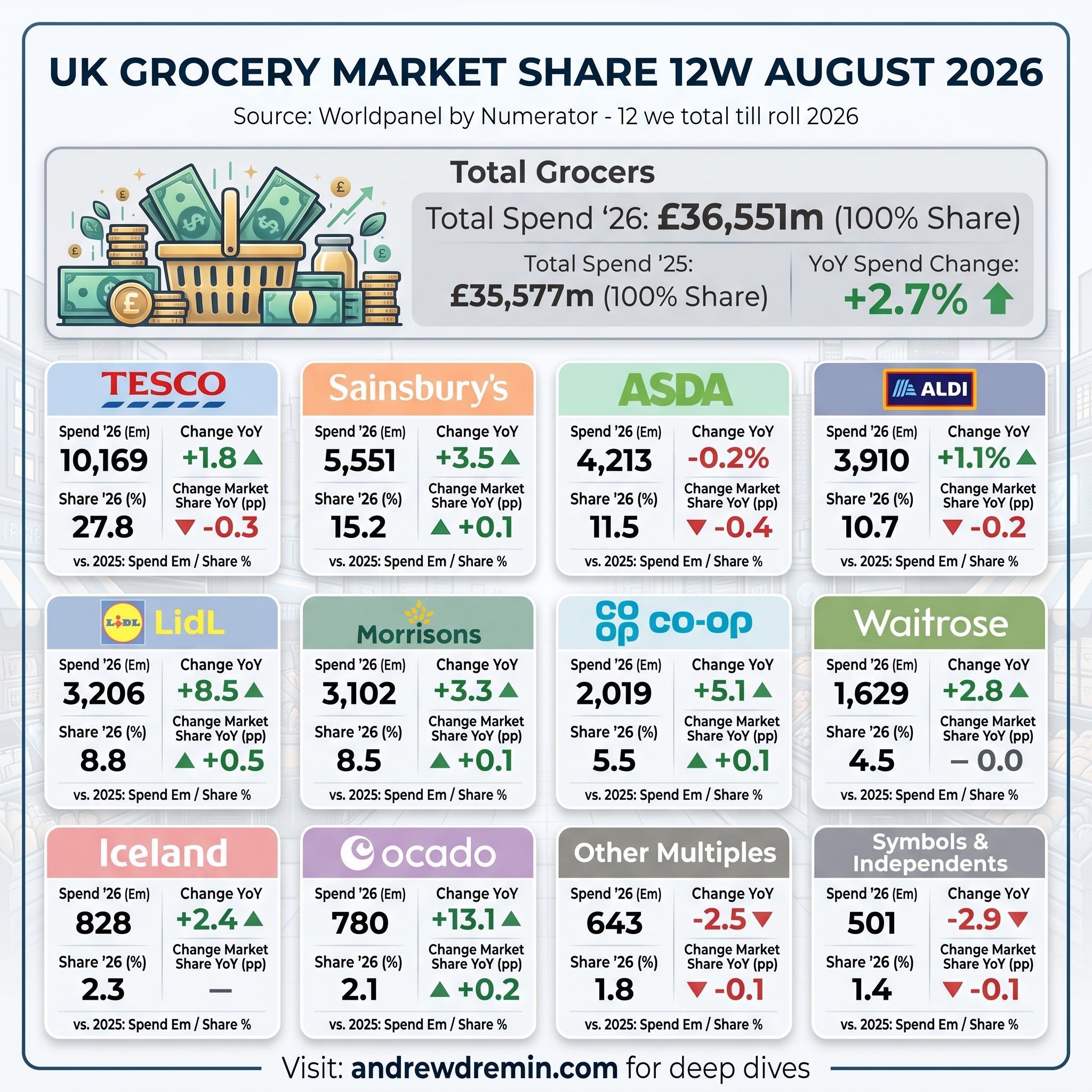
The UK grocery sector is going through a massive operational shift. Recent 12-week sales data shows a widening gap between traditional discounters, debt-loaded chains, and aggressive supermarket giants, highlighting key UK grocery market trends.
- Total UK grocery spend: Grew +2.7% to reach £36.55 billion.
- Lidl GB: Grew +8.5%, increasing its market share to over 8.1%.
- Sainsbury’s: Grew +3.5%, holding firm on core volume.
- Tesco: Grew +1.8%, protecting its dominant market leadership.
- Aldi UK: Grew only +1.1%, trailing market spend growth.
- Asda: Dropped -0.2%, losing market share down to 11.5%.
- Ocado: Surged +13.1%, leading the online channel.
In grocery retail, total sales spend includes price inflation. When market spend grows at +2.7%, any retailer growing at +1.1% or dropping into negative figures is losing physical unit volume. They are selling fewer boxes, crates, and tins off the shelf.
UK Grocery Market Share — 12W August 2026
Total Spend: £36,551m (+2.7% YoY)
Click to Expand / Collapse
| Retailer | Spend ’26 (£m) | Spend YoY (%) | Market Share (%) | Share YoY (pp) |
|---|---|---|---|---|
| Total Grocers | £36,551 | +2.7% | 100.0% | — |
| Tesco | £10,169 | +1.8% | 27.8% | -0.3 |
| Sainsbury’s | £5,551 | +3.5% | 15.2% | +0.1 |
| ASDA | £4,213 | -0.2% | 11.5% | -0.4 |
| Aldi | £3,910 | +1.1% | 10.7% | -0.2 |
| Lidl | £3,206 | +8.5% | 8.8% | +0.5 |
| Morrisons | £3,102 | +3.3% | 8.5% | +0.1 |
| Co-op | £2,019 | +5.1% | 5.5% | +0.1 |
| Waitrose | £1,629 | +2.8% | 4.5% | 0.0 |
| Iceland | £828 | +2.4% | 2.3% | — |
| Ocado | £780 | +13.1% | 2.1% | +0.2 |
| Other Multiples | £643 | -2.5% | 1.8% | -0.1 |
| Symbols & Independents | £501 | -2.9% | 1.4% | -0.1 |
Lidl vs Aldi Growth: The Battle for the UK Discounter Crown
For ten years, Aldi and Lidl grew side-by-side at double-digit rates. Today, their paths are splitting. Lidl is surging ahead while Aldi is struggling to beat inflation.
1. Fresh Bakery as a High-Frequency Traffic Driver
Lidl’s in-store bakery is not just a nice service. It is a proven footfall engine.
- Basket building: Fresh warm bread drives morning and midday shopper visits.
- Cross-category purchasing: A customer who enters for a fresh pastry buys milk, produce, and meat in the same trip.
- Sensory advantage: The smell of fresh bread creates a quality perception that balances low discounter prices.
Aldi operates mainly with packaged, pre-delivered bread. That difference directly impacts weekly visit frequency.
2. Flexible Real Estate and Store Formats
Aldi built its model on strict store size and standard box designs. Lidl took a more flexible approach:
- Opening stores inside city centers, retail parks, and non-standard urban units.
- Investing heavily in expanding sales floors in high-density areas across London and the South East.
- Adapting car park layouts and delivery logistics to fit complex physical locations.
3. Digital Personalization with Lidl Plus
Aldi long resisted digital loyalty schemes, relying purely on simple shelf-edge pricing. Lidl deployed the Lidl Plus app, giving them critical operational benefits:
- Personalized coupons based on actual purchase history.
- Real-time customer data tracking to manage stock and category range.
- Gamified spend targets (such as free products after spending a set monthly amount) that keep weekly volume inside their network.
Supermarket Loyalty Card Pricing: Neutralizing the Discounter Threat
The biggest strategic move by traditional supermarkets has been the rollout of member-only pricing. Tesco Clubcard Prices and Sainsbury’s Nectar Prices changed the rules of UK retail pricing.
How Tesco and Sainsbury’s Defend Core Volume
Traditional supermarkets used to lose shoppers who did their main shop at Tesco, then drove to Aldi for cheaper basic goods. Member pricing broke that habit:
- Price Matching on KVIs: Supermarkets match discounter prices on 500 to 600 Key Value Items (milk, eggs, bread, pasta, bananas).
- Two-Tier Shelf Tags: Non-members pay normal retail price; app users get direct discounts at the till.
- Friction Removal: If a shopper can buy discounted basic goods alongside their favorite branded products in one supermarket, they skip the trip to the discounter.
The Role of Retail Media Networks
Tesco and Sainsbury’s are not just discounting; they are funding these price cuts using supplier-paid advertising:
- FMCG brands pay for premium digital placement on retailer apps.
- Supermarkets use this high-margin advertising revenue to subsidize the retail price of staple food.
- Discounters without retail media networks must fund every single price cut straight from their gross margins.
Asda Market Share Decline: Operational Drag and Private Equity Debt
Asda’s fall to 11.5% market share is not caused by weak advertising. It is the direct consequence of heavy corporate debt and operational strain.
Why Debt Directly Damages Shelf Availability
When a business carries billions of pounds in leveraged debt, cash flow goes to interest payments instead of store operations:
- Capex Reduction: Less capital is spent on warehouse automation, refrigeration updates, and checkout maintenance.
- Labor Squeeze: Staffing hours on the shop floor get cut. Fewer workers mean pallets sit in the backroom instead of filling empty shelves.
- Availability Drops: When staple items are out of stock, customers do not wait. They switch to Tesco, Sainsbury’s, or discounters.
- IT System Transitions: Moving away from legacy systems has caused distribution and stock-counting errors, leaving store managers with missing inventory.
The Bifurcated Consumer: Premium Digital vs. Hard Value
The UK consumer market is splitting down the middle. Middle-tier propositions without clear value or top-tier service are losing out.
High income, digital orders, premium ranges
Physical footprint, aggressive pricing
1. High-Income Shoppers Value Time Over Pennies
Ocado’s +13.1% growth proves that affluent shoppers prioritize convenience, reliable delivery slots, and premium products (backed by Marks & Spencer). These customers are insulated from high food inflation and will pay for service quality.
2. Low-Income Shoppers Focus on Real Cash Outlay
Budget-conscious shoppers are cutting discretionary items completely. They look for:
- Private label basic tiers over major manufacturer brands.
- Fixed unit prices under £1.50 for dinner staples.
- Physical proximity to avoid driving long distances to out-of-town hypermarkets.
Retail Category Management Strategy: Practical Takeaways
For category managers, retail buyers, and FMCG suppliers, this market environment demands a clear operational strategy.
Five Operational Rules for Suppliers and Buyers
- Rock-Bottom Pricing Is Not Enough: If product quality is poor and availability is unstable, low price points will not protect volume.
- Focus on Fresh Category Execution: Produce, in-store bakery, and chilled meat drive footfall. If the fresh department fails, the dry grocery aisles lose volume automatically.
- Cut Slow-Moving SKUs: Retailers must remove mid-tier duplicate brands that clutter shelves. Focus inventory on one strong brand leader and two clear private label tiers (entry and premium).
- Partner on Retail Media: Suppliers must allocate trade spend into member pricing programs (Clubcard/Nectar/Lidl Plus) rather than generic mass promotions.
- Protect Supply Chain Fill Rates: With supermarkets running lean store labor, products must be shelf-ready (SRP packaging) to guarantee they get onto the shelf quickly without delays.
What trends are you seeing in your local stores? Are supermarket loyalty prices stopping you from shopping at discounters?
UK Grocery Market Share July 2026
The middle-class shopper is gone. They are wrong. These shoppers are not gone. They are just splitting their money in half.
| Retailer | Market Share (2025) | Market Share (2026) | YoY Value Change |
|---|---|---|---|
| Tesco | 28.1% | 27.9% | +1.7% |
| Sainsbury’s | 15.1% | 15.2% | +2.8% |
| Asda | 11.9% | 11.5% | -1.1% |
| Aldi | 11.0% | 10.8% | +0.7% |
| Lidl | 8.3% | 8.8% | +8.6% |
| Morrisons | 8.4% | 8.5% | +3.5% |
| Co-op | 5.2% | 5.4% | +5.6% |
| Waitrose | 4.4% | 4.4% | +2.5% |
| Iceland | 2.2% | 2.2% | +2.3% |
| Ocado | 2.0% | 2.2% | +14.1% |
Look at a normal family today. They have a very clear routine. First, they go to a discount store like Lidl. They buy bulk pasta, toilet paper, and basic cleaning supplies. They do this to survive inflation. Every penny counts on the basics. Then, they go home. They open their laptop and order premium steaks, craft beer, and nice cheese from Ocado for the weekend.
In my 15 years in retail procurement, I rarely see the market split this clearly. People want extreme value or extreme convenience. There is no loyalty to just one store anymore. If you sit in the middle with bad service, you lose customers fast.
The Winners: Extreme Value and Extreme Convenience
Lidl and Ocado own the edges of the market.
Lidl added 0.5% to their total market share, reaching 8.8%. In the slow grocery business, this is a massive jump. They do the hard discount model perfectly. They do not build fancy stores or hire extra staff. They just put cheap, good products on pallets. It works.
Ocado gained 0.2% share, reaching 2.2%. Their sales grew by an impressive 14.1%. This is premium delivery. People gladly pay extra for the convenience, the correct orders, and the high-end brands.
These two do not fight each other. They sell to the exact same middle-class family, just for different needs and on different days.
The Middle Ground vs. The Failures
The traditional middle of the market is a mixed picture.
Tesco’s international business and Sainsbury’s are holding on. They are fighting back and growing their sales. Sainsbury’s grew by 2.8%, and Tesco grew by 1.7%. How do they do it? They use aggressive price-matching and their loyalty cards. Clubcard and Nectar force customers to return by locking the best prices behind the cards. They are protecting their core business.
Asda is failing. Asda dropped 1.1% in sales and lost 0.4% market share in one year. This is brutal. This is not a pricing problem. This is a structural failure. Asda has heavy corporate debt and messy IT systems. When the head office struggles, the physical stores suffer. Shelves sit empty. Staff are overworked. Shoppers notice this mess instantly, and they leave. Bad operations destroy profits much faster than bad prices.
The Rest of the Market
The other stores show clear trends:
- Aldi is slowing down: They lost 0.2% share. Lidl is clearly winning the discount war right now.
- Morrisons and Co-op bounce back: Both grew their sales well. They are successfully picking up quick, local shopping trips.
- Waitrose and Iceland stay the same: They know their specific customers and sit quietly without taking big risks.
What Food Brands Must Do Now
If you sell food or consumer goods, you must adapt today. Stop using plans from 2019. You have to work with the current numbers, or stores will stop buying your products. Here is how to fix your approach:
- Split your products: You cannot sell the exact same items everywhere. Send your high-volume, basic products to the discounters. Keep your premium, nice-to-have items for online delivery like Ocado.
- Check the shelves: Do not waste your marketing money on struggling stores. If Asda cannot physically keep your product on the shelf because their operations are a mess, your money is wasted. Demand proof that products are available before you pay them for promotions.
- Protect the middle: If you sell to Tesco or Sainsbury’s, join their loyalty campaigns. Pay to be part of Clubcard or Nectar prices. It costs money, but losing that prime shelf space is a fatal error.
Consumers buy cheap basics so they can afford weekend treats. This is the new rule. Retailers and brands that ignore this will keep losing money.
Look at the facts. Stop guessing. If you want an honest review of your sales strategy or commercial operations, send me a message. I work directly with brands to fix their retail profits.

FAQ: UK Grocery Market Share 2026
What is the projected market share for UK supermarkets in 2026?
Tesco remains the undisputed market leader, holding approximately 27% of the market. Sainsbury’s follows securely in second place. However, the traditional “Big Four” continue to lose incremental share to discounters, fundamentally reshaping the competitive landscape.
How much market share do Aldi and Lidl hold in the UK?
By 2026, Aldi and Lidl’s combined market share is pushing towards the 18-20% mark. Their aggressive store expansion and premiumization of private labels have cemented their status not just as discounters, but as primary weekly shopping destinations for British consumers.
Is Asda or Morrisons losing more market share?
Both have faced significant pressure since their private equity buyouts, dealing with heavy debt burdens that limit price investments. Morrisons lost its position in the Big Four to Aldi earlier in the decade, while Asda has struggled to defend its core customer base from discount competitors.
What is the current share of online grocery shopping in the UK?
Online grocery sales have stabilized at around 11-12% of total market share. While the hyper-growth of the pandemic era is over, retailers are shifting focus from expanding delivery slots to improving the profitability of online orders through retail media networks and automated fulfillment centers.
Related posts:
 Emerging Megacities: FMCG Retail Trends and Consumer Shifts by 2050
 Aldi vs Tesco Sainsbury Loyalty Schemes: 2026 Analysis
 How Mercadona outperforms Carrefour through EDLP models and KVI consumer perception
 Global IQ Ranking by Country 2026: Top 50 Data Audit
 US Fast Food locations Rankings 2026: Chick-fil-A vs Subway Data
 Europe FMCG Retail Penetration 2026 Insights
Leave a Reply