
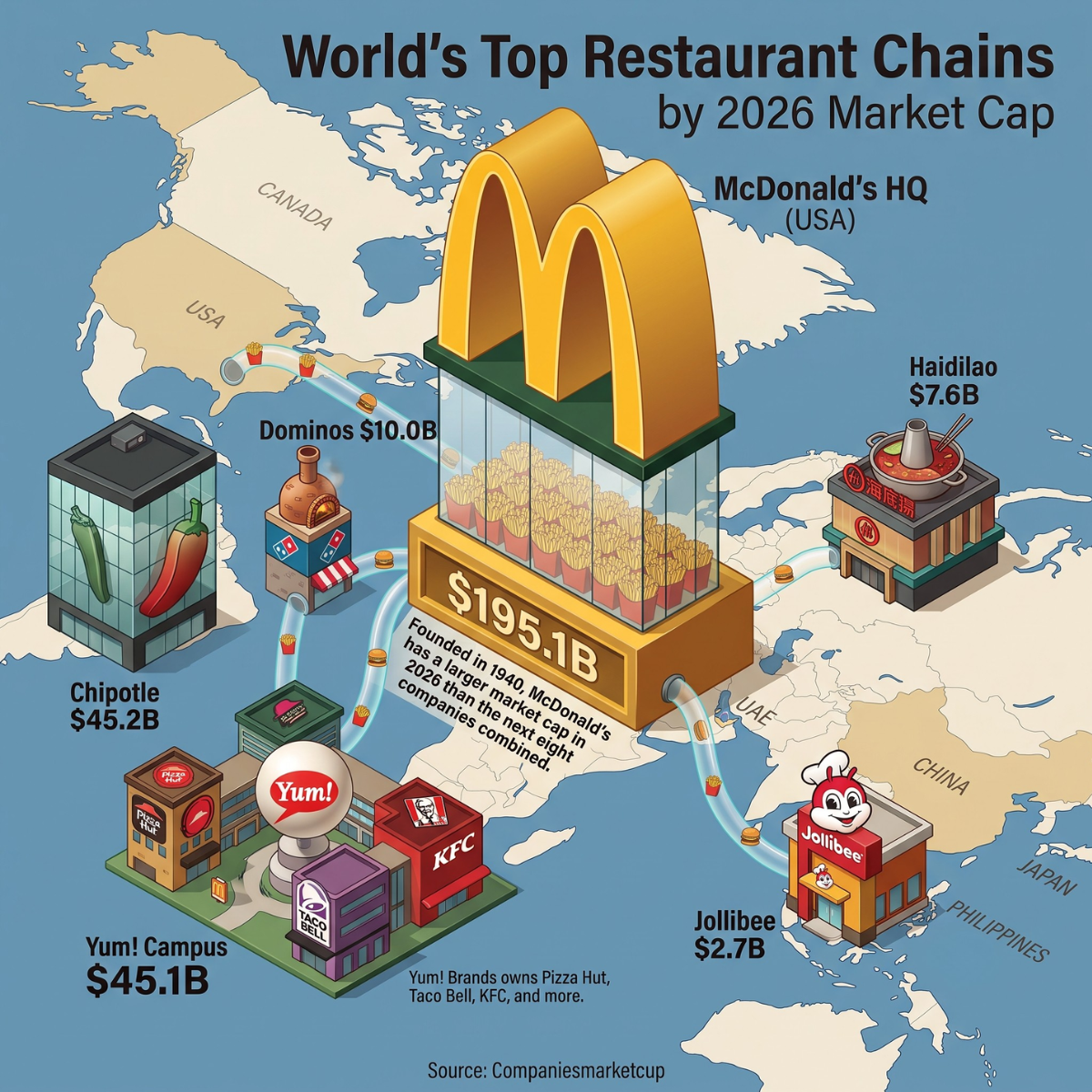
$195.1 billion. That is the massive market cap of McDonald’s in July 2026. The burger giant is no longer just a food business. It operates as a real estate monopoly disguised as a fast-food chain.
To understand this valuation, you must look at the underlying business model. McDonald’s does not make most of its money from selling burgers. It makes money by buying prime physical locations and leasing them back to its franchisees, often with large markups. The corporate entity acts as a landlord. Franchisees pay regular rent alongside royalty fees based on gross sales.
This structure provides two distinct financial advantages. First, it insulates the parent company from fluctuations in food inflation and operating costs. If wages or ingredient prices rise, the franchisee bears the operational risk, while the corporate entity collects stable real estate income. Second, it creates a massive asset portfolio that appreciates over time. The phrase “real estate monopoly” is often used here. While it is not a literal monopoly under anti-trust law, it represents an unmatched concentration of top-tier retail locations globally. This physical footprint forms a barrier to entry that no new competitor can easily replicate, regardless of how good their food is.
Deconstructing the 2026 Global Landscape Data
Look at the latest market data. McDonald’s is valued higher than the next eight restaurant giants combined. But the real battlefield is happening just below the surface. Fast-casual players are challenging traditional fast food.
| Brand | Market Cap (July 2026) | Primary Business Model |
| McDonald’s | $195.1 Billion | Real Estate & Franchise |
| Chipotle Mexican Grill | $45.2 Billion | Corporate-Owned & Fast-Casual |
| Yum! Brands | $45.1 Billion | Asset-Light Franchise |
| Domino’s Pizza | $10.0 Billion | Digital-First Delivery |
| Zensho (Japan) | $8.5 Billion | Diversified Multi-Brand |
| Cava | $8.4 Billion | Mediterranean Fast-Casual |
| Haidilao (China) | $7.6 Billion | Experiential Hot Pot |
| Jollibee (Philippines) | $2.7 Billion | Global Multi-Brand Franchise |
Chipotle Mexican Grill sits at $45.2 billion, beating Yum! Brands ($45.1B). This is a significant shift in retail history. Yum! Brands controls three massive global legacy marks: KFC, Taco Bell, and Pizza Hut. Yet, Chipotle, operating a single brand with a strictly corporate-owned model rather than franchising, commands a higher valuation. Investors are clearly paying a premium for Chipotle’s direct control over operations and its high-margin unit economics.
At the same time, fresh concepts like Cava ($8.4B) are rising fast by applying the Chipotle assembly-line system to Mediterranean food. Meanwhile, international players like Zensho (Japan, $8.5B) and Jollibee (Philippines, $2.7B) are expanding their global footprints. They are targeting regional niches and diaspora markets, showing that the global restaurant market is no longer a purely American playground.
Fast-Casual vs. Classic Fast Food
When reviewing category performance during retail strategy audits, two distinct models emerge:
- Traditional Fast Food (e.g., McDonald’s, Burger King via RBI): Built on extreme supply chain optimization, massive scale, and asset-light franchising. But they face heavy consumer pushback on quality.
- Fast-Casual (e.g., Chipotle, Cava): Focused on higher ingredient quality and transparent kitchen assembly. Customers pay a premium because they want real food.
Think about the average consumer in 2026. They are tight on budget due to years of accumulated inflation, but they refuse to buy low-quality fillers. The price gap between classic fast food and fast-casual has narrowed significantly. In the past, traditional fast food was chosen purely because it was cheap. Today, a standard value meal at a traditional chain can easily cost $9 to $11.
When consumers face these prices, their psychological calculation shifts. They choose a $12 fresh burrito or a Cava bowl over a $9 processed value meal because the value feels real. The fast-casual model wins because it offers a higher perceived utility per dollar spent. It combines the speed of fast food with the ingredient integrity of a casual dining restaurant.
How to Choose Your Next Expansion Strategy
Retailers and FMCG brands looking to partner or expand can use this quick framework to guide investment:
1. Evaluate Supply Chain Agility
If your local suppliers cannot scale fast, avoid high-volume fast-food models. Choose localized fast-casual instead. Fast-casual concepts rely heavily on fresh, chilled supply chains rather than deeply frozen, heavily processed foods. If your market lacks advanced cold-chain logistics, a legacy fast-food model or a digital delivery brand is a safer infrastructure bet.
2. Prioritize Real Estate Footprint
Monopolies like McDonald’s win on locations, not just recipes. If you cannot secure top-tier physical spots with high foot traffic or drive-thru capabilities, do not try to compete head-on. Instead, focus on digital-first delivery brands like Domino’s ($10.0B). Domino’s proves that you can build a highly valuable business by treating food delivery as a software and logistics problem, allowing you to use cheaper, secondary real estate locations.
3. Monitor Regional Flavor Shifts
Brands like Haidilao (China, $7.6B) prove that experiential dining still commands high margins. Consumers are increasingly willing to pay for unique cultural concepts and high table service quality, even during economic downturns.
The Long-Term Outlook: Scale vs. Sustainability
Is the fast-casual boom sustainable, or will the scale of traditional fast food always win?
The answer depends on margins and real estate. Fast-casual brands enjoy high popularity and pricing power right now. However, their corporate-owned models mean they carry high capital expenditures. They must pay for their own store build-outs and staff them in an expensive labor market.
Traditional fast food, backed by billions in real estate assets and global supply chain leverage, remains highly defensive. When a recession hits hard, absolute price floors matter. McDonald’s can drop prices or launch aggressive value platforms because its global supply chain can absorb the shock. Fast-casual cannot easily slash prices without destroying its identity or ingredient quality. The fast-casual boom is sustainable, but it will not eliminate classic fast food. Instead, it forces legacy players to modernize their menus or risk losing the high-spending middle-class demographic forever.


