
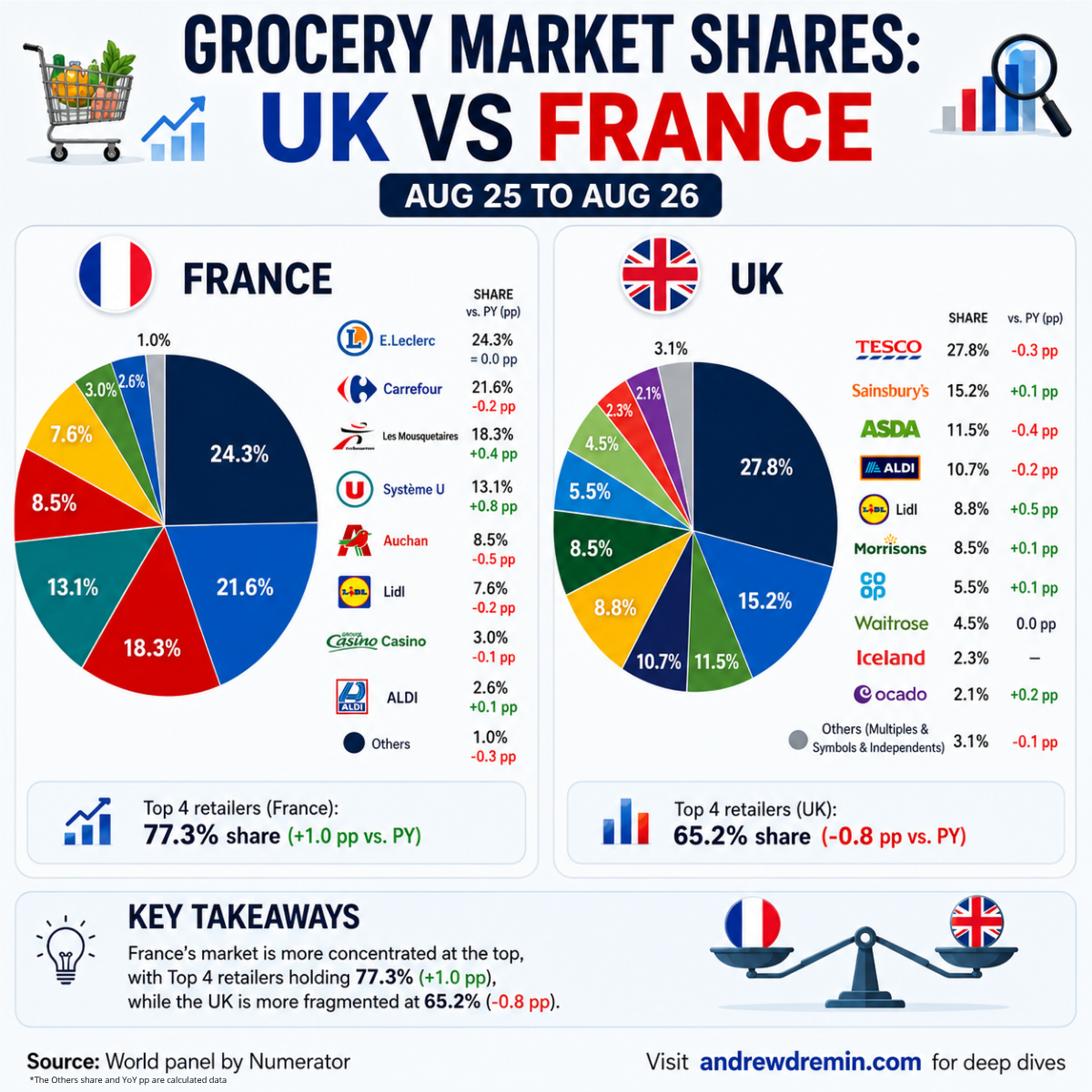
This article explores projections and current figures regarding UK France grocery market share 2026. On paper, the French grocery market looks like a tight oligopoly. The top four retail groups in France –.Leclerc, Carrefour, Groupement Les Mousquetaires (Intermarché), and Système U- control roughly 77.3% of the grocery market. In the United Kingdom, the top four grocers – Tesco, Sainsbury’s, Asda, and Morrisons – hold about 65.2%.
| Country | Market Share (Top 4) |
|---|---|
| France | 77.3% |
| United Kingdom | 65.2% |
A basic market concentration index would suggest that France is easier to negotiate with and more uniform to distribute across than the UK. In commercial reality, the exact opposite is true.
The UK operates as a consolidated, top-down commercial machine where a single buyer controls national distribution. France operates as a decentralized, legally strict battlefield where independent store owners, state price regulations, and aggressive purchasing alliances dictate the real terms of trade.
Centralized Integrated Chains vs Independent Cooperatives
The biggest structural difference between the two markets comes down to corporate governance.
| UK (Integrated Chains) | France (Cooperatives & Mixed) |
|---|---|
|
HQ Central Desk
|
HQ Central Desk
|
| (Direct Order) ↓ | (Assortment List) ↓ |
|
Stores follow 100%
of planograms/prices |
Independent Owners
pick local stock |
The UK Model: Top-Down Central Control (Tesco, Sainsbury’s)
In the UK, the major chains (Tesco, Sainsbury’s, Asda, and Morrisons) are integrated corporate entities:
- Single Point of Contact: One category buyer and one supply chain manager at headquarters make the final decision for the whole estate.
- National Planograms: If a brand wins a listing for 600 stores, the head office pushes the planogram into the system. Store managers must execute it.
- Uniform Pricing: Retail prices, promotional calendars, and shelf positions are identical across all standard format stores in the country.
- Direct Logistics: Stock moves through centralized distribution centers (DCs) straight to shelves with minimal store-level friction.
The French Model: Independent Store Owners and Regional Hubs
In France, three of the four dominant players (E.Leclerc, Les Mousquetaires, and Système U) are cooperative groups (les indépendants):
- The Adhérent System: Each store is owned and run by an independent entrepreneur (adhérent). They own their legal entity, own the real estate, and make local business decisions.
- HQ Signs the Frame, Not the Shelf: When an FMCG brand signs a national contract with E.Leclerc’s central desk (Galec), the brand is only listed in the national product catalog (le référencement).
- Local Assortment Decisions: Individual store owners decide whether to order the product, how many facings to give it, and what final shelf price to charge.
- Field Sales Dependency: A brand cannot survive in France with just a key account manager at HQ. You need a dedicated field sales force (chefs de secteur) visiting individual hypermarkets and supermarkets to sell the product into the backroom.
Why German Discounters Conquered the UK but Stalled in France
Aldi and Lidl reshaped the UK retail market over the last fifteen years. In France, their growth hit a firm ceiling.
| Region | Combined Market Share (Aldi & Lidl) |
|---|---|
| United Kingdom | ~19.5% |
| France | ~10.2% |
| UK GROCERY MARKET | FRENCH GROCERY MARKET |
|---|---|
|
|
UK Supermarket Defense: Loyalty Pricing and Supplier-Funded Margins
In the UK, traditional supermarkets initially lost significant ground to German discounters because the price gap on core staples was wide (often 15% to 25%).
To stop this loss of market share, UK grocers changed tactics:
- Member-Only Pricing: Tesco introduced Clubcard Prices, followed by Sainsbury’s Nectar Prices. Discounts are locked behind mobile apps.
- Aldi Price Match: Supermarkets created direct price-matching schemes on hundreds of everyday SKUs.
- Supplier-Funded Defense: Grocers pushed the cost of these discount programs back onto FMCG manufacturers through commercial funding agreements and trade spend deductions.
French Regulatory Moats: EGalim Laws and the Drive Network
In France, Aldi and Lidl could not replicate their UK success due to local price dynamics, strict legislation, and local buying habits:
- E.Leclerc’s Price Wall: Long before discounters expanded, E.Leclerc established itself as the absolute price leader in France, running lower gross margins on food than standard European retailers.
- EGalim Promotional Restrictions: French EGalim laws restrict price promotions on food products to a maximum value discount of 34% and a maximum volume limit of 25%. Retailers cannot run chaotic price wars on food.
- Resale Below Cost Floor (SRP+10): French law bans selling food below cost and mandates a minimum 10% gross margin threshold (Seuil de Revente à Perte). This prevents discounters and hypermarkets from using food staples as extreme loss leaders.
- The “Drive” Infrastructure: French grocers invested heavily in click-and-collect warehouse hubs (le Drive). E.Leclerc and Intermarché built thousands of drive locations outside French cities, capturing family bulk-buying trips before discounters could build out their brick-and-mortar stores.
Negotiation Power: Buying Alliances and the March 1 Deadline
Annual commercial negotiations (les négociations commerciales) differ fundamentally between the two countries in both timing and buyer concentration.
| Annual Negotiation Dynamics |
|---|
FRANCE: The March 1 Deadline
|
UNITED KINGDOM: Continuous JBP Reviews
|
The French “Négos Commerciales” and European Purchasing Hubs
French grocery buying is organized around concentrated joint purchasing desks:
- Massive Purchasing Alliances: Retailers join forces to buy national and multinational FMCG brands together. Three major purchasing desks control over 85% of total French retail purchasing.
- The Hard March 1 Cutoff: French law dictates that all annual commercial terms between suppliers and retailers must be fully agreed and signed by March 1.
- Delisting Risk: If a supplier and a buying alliance fail to reach an agreement before midnight on March 1, the commercial relationship enters a legal blackout. The retailer stops issuing purchase orders, leading to immediate delistings across thousands of stores.
- European Buying Desks: To challenge French retail price regulations, major groups shifted purchasing entities for global multinational brands to Switzerland, Belgium, or the Netherlands (e.g., Everest, Eurelec, Epic).
The UK GSCOP Framework and Continuous JBP Reviews
The UK does not have a single legal annual deadline:
- Rolling Joint Business Plans (JBPs): Negotiations take place on rolling category review cycles throughout the financial year.
- The Groceries Supply Code of Practice (GSCOP): UK negotiations are regulated by GSCOP, enforced by the Groceries Code Adjudicator (GCA). Retailers cannot delist suppliers overnight without legitimate commercial notice and a formal review process.
- Cost Price Increase (CPI) Processes: When suppliers need to raise prices, they submit detailed CPI dossiers. Retailers push back through open-book cost accounting and margin negotiations, but the process does not depend on a single national deadline.
Strategic Playbook for FMCG Brands
Operating in these two markets requires distinct commercial strategies:
| FMCG Commercial Playbook |
|---|
UNITED KINGDOM
|
FRANCE
|
1. Structure Your Revenue Management Differently
- In the UK: Build your margins to accommodate heavy promotion funding, app-based loyalty discounts, and digital retail media networks on retailer platforms.
- In France: Because EGalim caps promotions at 34% value and 25% volume, retail buyers care far less about complex promo packages. Focus all your energy on defending the base list price and the net-net cost per case.
2. Tailor Your Commercial Team Structure
- In the UK: Maintain a lean, analytical Key Account Management (KAM) team focused on central buyer relationships, joint business planning, category management, and supply chain fill rates.
- In France: Split your investment between high-level negotiators capable of handling alliance purchasing desks and a field sales network (force de vente) that can visit store managers across regions to secure shelf space.
3. Plan for Contract Timing and Supply Chain Risks
- In the UK: Build pricing discussions around your internal raw material cycles and formal cost price increase (CPI) submission windows.
- In France: Prepare for intense operational stress between December and February. Set clear commercial walk-away positions ahead of the March 1 deadline, and prepare your supply chain for potential temporary stop-shipments if talks go down to the final hours.
Frequently Asked Questions (FAQ)
What is the French EGalim law in grocery retail?
Why do French independent retailers have more power than UK store managers?
What is the March 1 deadline in French retail negotiations?
How does GSCOP protect food suppliers in the UK?
Why did Aldi and Lidl capture more market share in the UK than in France?
Related posts:
 Emerging Megacities: FMCG Retail Trends and Consumer Shifts by 2050
 Minimum Wages PPP by Country 2026: Poland Hits $2.1K
 Aldi vs Tesco Sainsbury Loyalty Schemes: 2026 Analysis
 Spain Grocery Market Share 2026: Why Giants Flatline
 Seasonal Retail Inventory Management: 85/15 Buffer Model
 Spain Grocery retail market share July 2026
Leave a Reply