
The North American yogurt market grew 11% last year, yet Danone’s volume dropped 2%. Following these weak metrics, financial firm Jefferies downgraded Danone to “Underperform” and cut its price target to €62. Many industry analysts quickly claimed that brand loyalty in consumer goods is dead.
That conclusion is wrong. Brand loyalty is not dead. It is polarized.
Shoppers are splitting into two distinct groups. On one side are cost-driven buyers who want cheap, reliable staples. On the other side are benefit-driven buyers willing to pay extra for functional nutrition like high protein, low sugar, or specific gut-health benefits. The middle ground – where standard products sell at a premium price just because they carry a famous logo – is dying.
The Retail Aisle Reality: Private Labels Took Control
The Price Gap and Changing Consumer Habits
Walk down a dairy aisle in Consum today. A parent stands in front of the display, looks at a standard 4-pack of store-brand yogurt priced at €1.70, and then compares it to Danone’s baseline offering at €2.99. In most cases, Danone goes back on the shelf.
Recent inflation forced household budgets to tighten. Consumers who had bought A-brands for years were forced to try private labels. They discovered two critical facts:
- The quality of store-brand dairy is completely fine.
- Large contract manufacturers often supply both private labels and national brands using similar raw milk and production standards.
Once a consumer learns that a €1.70 store brand delivers 90% of the quality of a €2.99 brand, they do not switch back to standard products at full price. The premium justification for basic yogurt is broken.
Danone’s High-Stakes Strategy: Functional Upgrades vs. Promo Traps
The Risk of Mass Promotions
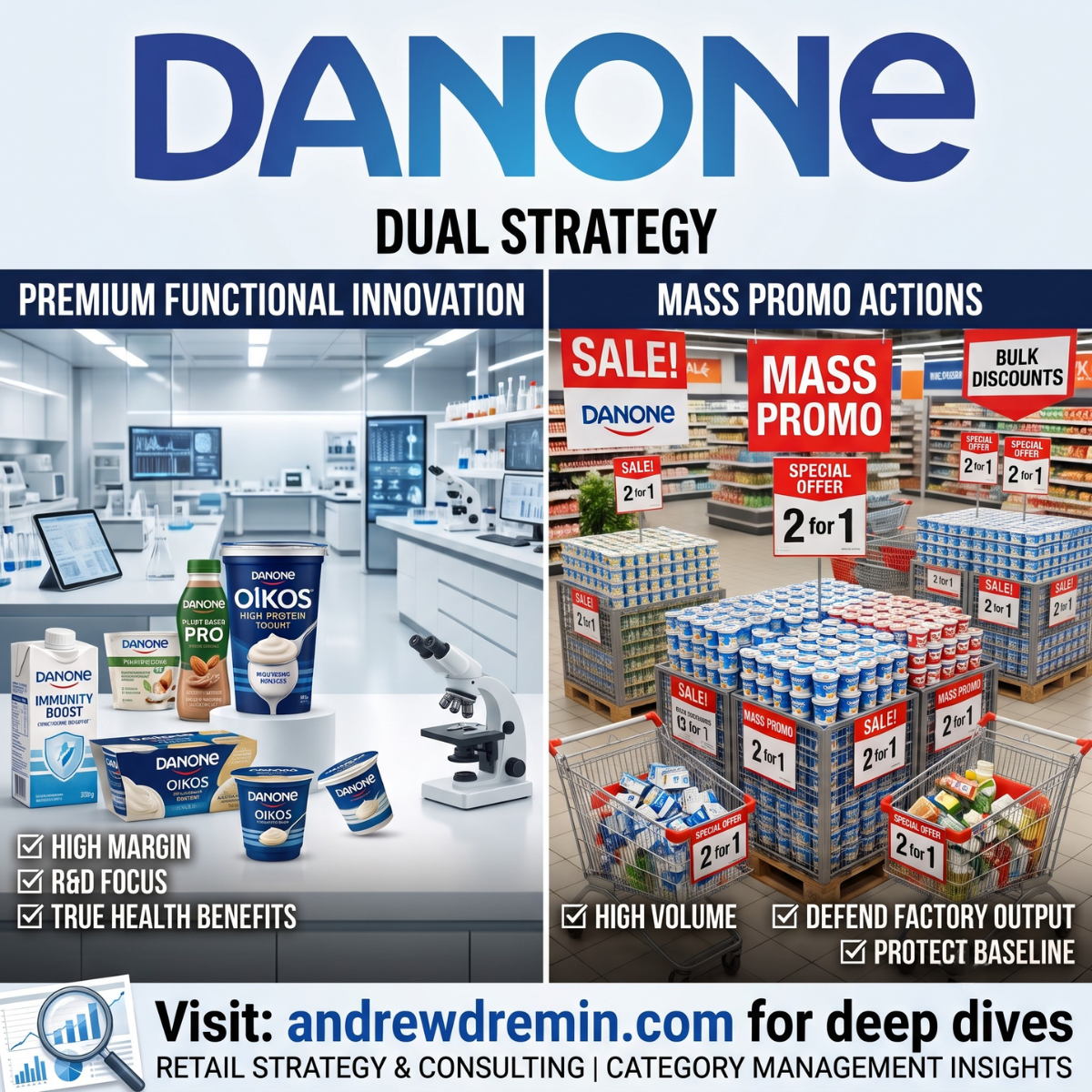
Industry reports from Merca2 and Jefferies highlight that Danone refuses to slash its baseline list prices to fight store brands directly. Instead, Danone is running an aggressive dual strategy: heavy innovation in premium functional lines, paired with deep promotional discounts to move basic volumes.
This approach carries a major operational risk.
Dairy processing plants have high fixed operating costs and strict raw milk supply contracts. Processing plants must keep running at high capacity to maintain efficiency. Deep promotional discounts – like 3-for-2 deals or 50% off the second item – protect factory volume in the short term. However, this strategy creates a promo trap.
When you run constant discounts, you train shoppers never to pay full price. The high list price becomes fake, margins bleed, and brand equity erodes.
Why Functional Innovation Works
On the other hand, Danone’s shift toward functional lines (such as YoPRO or high-protein Greek offerings) is logical. Private labels take 12 to 18 months to copy complex recipes, functional health claims, and specialized packaging. Consumers will pay €2.50 or more for a single protein pot if they believe it supports their workout or diet goals. Real health benefits justify higher prices; simple heritage logos do not.
Why Retailers Still Need Expensive National Brands
The Mechanics of Price Anchoring
Supermarket chains like Mercadona, Carrefour, or Lidl do not want national A-brands to disappear entirely. They need them on the shelf for psychological reasons.
In retail pricing strategy, an expensive brand acts as a price anchor. If Danone sits on the shelf at €2.99, the retailer’s private label at €1.70 looks like an obvious financial win for the shopper. It makes the consumer feel smart for saving money.
If the €2.99 national brand vanishes, the store brand loses its reference point. It is no longer a cheap alternative; it simply becomes the default price. Without high-priced anchors, retailers lose the visual contrast that drives their high-margin private label sales.
Actionable Takeaways for FMCG Brands and Retailers
Strategic Rules for FMCG Brand Managers
- Exit the standard middle ground: Stop relying on heritage. If a product offers standard taste and basic nutrition, private labels will crush your margins. Shift research and development budgets into functional formulas that store brands cannot duplicate quickly.
- Stop relying on promo addiction: Temporary discounts keep production lines busy, but destroy baseline profitability. Use targeted trade spend instead of broad, volume-dumping promotions.
- Fix production and supply chain costs: If factory inefficiencies force high shelf prices on standard products, retailers will trim your facings in the next shelf review.
Playbook for Retail Category Managers
- Maintain strategic price anchors: Keep key national brands visible on shelf, but limit their total facings. Use their high prices to highlight your store-brand value proposition.
- Develop premium private label tiers: Do not stop at basic commodities. Build high-protein, organic, and lactose-free private labels before national brands lock in those high-margin consumers.
- Tie facing space strictly to performance: Allocate shelf space based on real margin contribution and innovation, not legacy supplier relationships. If an A-brand fails to bring real innovation, cut its space.
The Final Choice for Legacy Portfolios
The retail shelf is reorganizing faster than ever. Danone is actively attempting to buy its way out of the middle ground by acquiring and investing in functional, high-growth nutrition brands like Huel and specialized dairy alternatives.
For legacy FMCG managers, the lesson is straightforward: you cannot win a direct price war against private label manufacturers who have lower overhead costs and guaranteed shelf placement from retailers. You must either innovate into higher-value functional niches or cut cost structures down to commodity levels.
If you manage a traditional FMCG portfolio today, what is your practical plan to exit the private-label price trap before your volume disappears?
Related posts:
 Why Mercadona’s 27.4% Market Share Is Misleading
 The Billion-Dollar Illusion: How a Fake Movie Parade Transformed Global Retail and Tourism
 The Summer of 2026: A Different Kind of Retail War
 The Supermarket That Wants to Be a Restaurant
 889 резюме на одну вакансию.
 Why Tesco is Walking Away from Central Europe and What Retail Leaders Must Learn
Leave a Reply