
The 2026 World Cup radically altered the Spanish shopping basket this summer. Supermarkets experienced a massive shift in consumer behavior. Data shows that when Spain played, snack sales jumped by 29%, pickles and olives spiked by 30%, and beer sales increased by 14%. Consumers did not buy at the last minute. The average pre-match purchase happened a day in advance, with a typical ticket of €33.83.
But while FMCG managers focus on the spike in chips and beer, a much more brutal retail war happens quietly on the shelves. It is not about World Cup retail promotions. It is about a fundamental shift in how supermarkets price their private labels.
The Fartons Pricing Anomaly
Consider Mercadona’s grocery market share. They just flipped the established rules of private label pricing upside down.
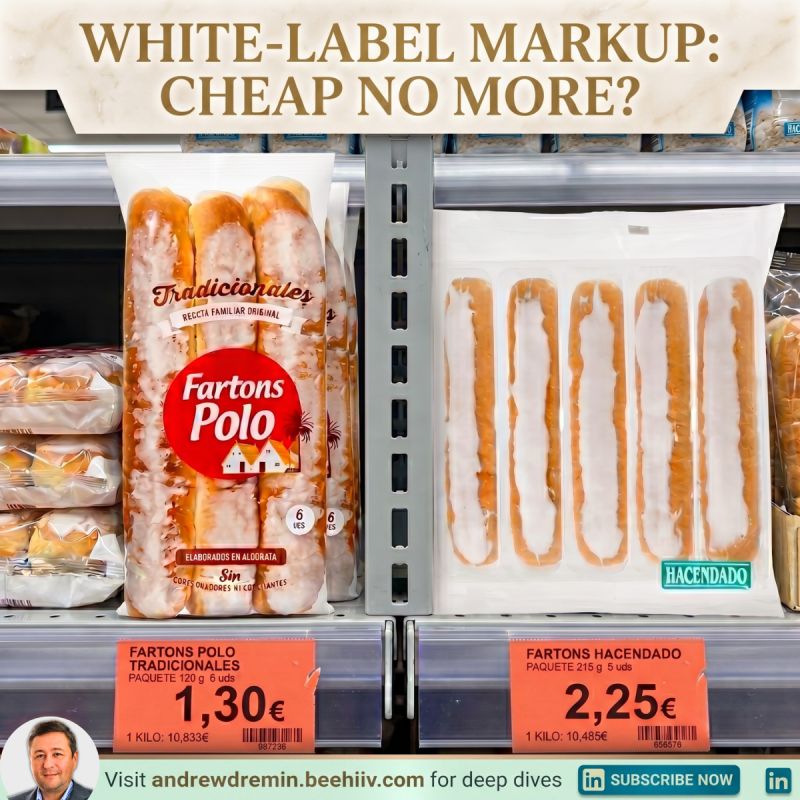
With summer temperatures rising, Mercadona re-introduced their traditional “fartons” – the sweet buns specifically made to dip into cold horchata. They placed their house brand, Hacendado, right next to the undisputed market leader, Fartons Polo.
This is standard retail practice. The supermarket brand sits next to the national brand. Normally, the store brand is the cheaper alternative.
But the price tag on the shelf shocked shoppers:
- Fartons Polo: 6 units for €1.30.
- Hacendado: 5 units for €2.25.
A store brand costing nearly double the absolute price of the national leader? It looks like a massive mistake. At first glance, it reads as absolute corporate greed. Shoppers assume the retailer lost its mind.
The Hidden Math Behind the Price Tag
As a critical analyst, I do not take consumer outrage at face value. We need to test the hypothesis: is Mercadona simply overcharging?
The math tells a completely different story.
Look closely at the product weight. The Fartons Polo pack weighs 120 grams in total. Each bun is a light 20 grams. The Hacendado pack weighs 215 grams. Each bun is 43 grams -more than double the size of the competitor.
When you calculate the actual price per kilo, the Hacendado product is fractionally cheaper than Polo.
This is not corporate greed. It is a calculated strategy shift. Mercadona refuses to play the traditional private label game. Instead of making a cheap, inferior copy of the market leader, they engineered a larger, heavier, premium version of the product.
The Trap of Shrinkflation
In recent consulting calls, retail clients ask me why a massive chain like Mercadona takes such a heavy pricing risk.
The reality is that supermarkets no longer have a choice.
For the past three years, national brands aggressively used shrinkflation to protect profit margins against rising costs. Reports show that roughly 7% of the Spanish shopping basket is now affected by shrinkflation.
The examples are everywhere. A classic Frigo Pie ice cream shrank from 62 grams to 42 grams while its price climbed by 25%. Campofrío sliced ham dropped from 110 grams to 90 grams per pack. Cola-Cao reduced its standard tub from 800 grams to 760 grams. Margarine tubs fell from 500 grams to 450 grams.
National brands keep making their products smaller and using cheaper ingredients. If a supermarket simply copies the national brand, their private label also gets smaller and worse.
This damages the supermarket’s own reputation. Retailers realize they must step in. They build real volume and premium quality into their private labels to capture the consumer trust that national brands throw away.
The Psychology of the Supermarket Aisle
Mercadona’s strategy makes perfect logical sense in a spreadsheet. But retail does not happen in a spreadsheet. It happens on a physical shelf.
This is the weak point in their logic. They ignored basic human psychology.
The average consumer pushing a shopping trolley does not do division at the shelf. They do not calculate the price per gram. A stressed, rushed shopper simply looks at the two boxes. They see fewer buns (5 versus 6). They see a much higher price (€2.25 versus €1.30).
The immediate emotional response is that they are being cheated.
When you force a shopper to do math to understand your value proposition, you fail. The brain defaults to the easiest visual cue. In this case, the visual cue says the store brand is a rip-off, even though it is technically the better deal.
Conclusions for FMCG Managers
The private label sector is changing rapidly. You must adapt, but you must remain grounded in how people actually shop.
- Expect Private Labels to Bulk Up: As national brands continue to shrink package sizes to hide inflation, major retailers will go the opposite direction. Store brands will get bigger and heavier. They will position themselves as the only honest volume left on the shelf.
- Shelf Psychology is King: You can engineer the best product in the category, but if the packaging does not communicate the value instantly, it will not sell. If you upgrade your store brand to a premium weight, the packaging must look premium. The size difference must be visually obvious from two meters away.
- Stop Relying on the Price Tag: Do not expect the tiny “price per kilo” text on the shelf label to do your marketing. If your absolute price is nearly 80% higher than the market leader, you need aggressive visual cues to justify it.
The FMCG landscape shifts constantly. Supermarkets hold the power, but they still trip over their own strategies when they forget how a human makes a split-second decision.
Related posts:
 ТОП Работодателей Европы 2026: FMCG
 The Billion-Dollar Illusion: How a Fake Movie Parade Transformed Global Retail and Tourism
 Inditex Q1 2026 Performance
 The €3.90 Gourmet Threat: How Supermarket Meal Kits are Disrupting Fast Casual Dining
 Spain reached 19th place on the 2026 HelloSafe Prosperity Index
 The Supermarket Grocerant Trend: Why Retailers Are Stealing Restaurant Profits