
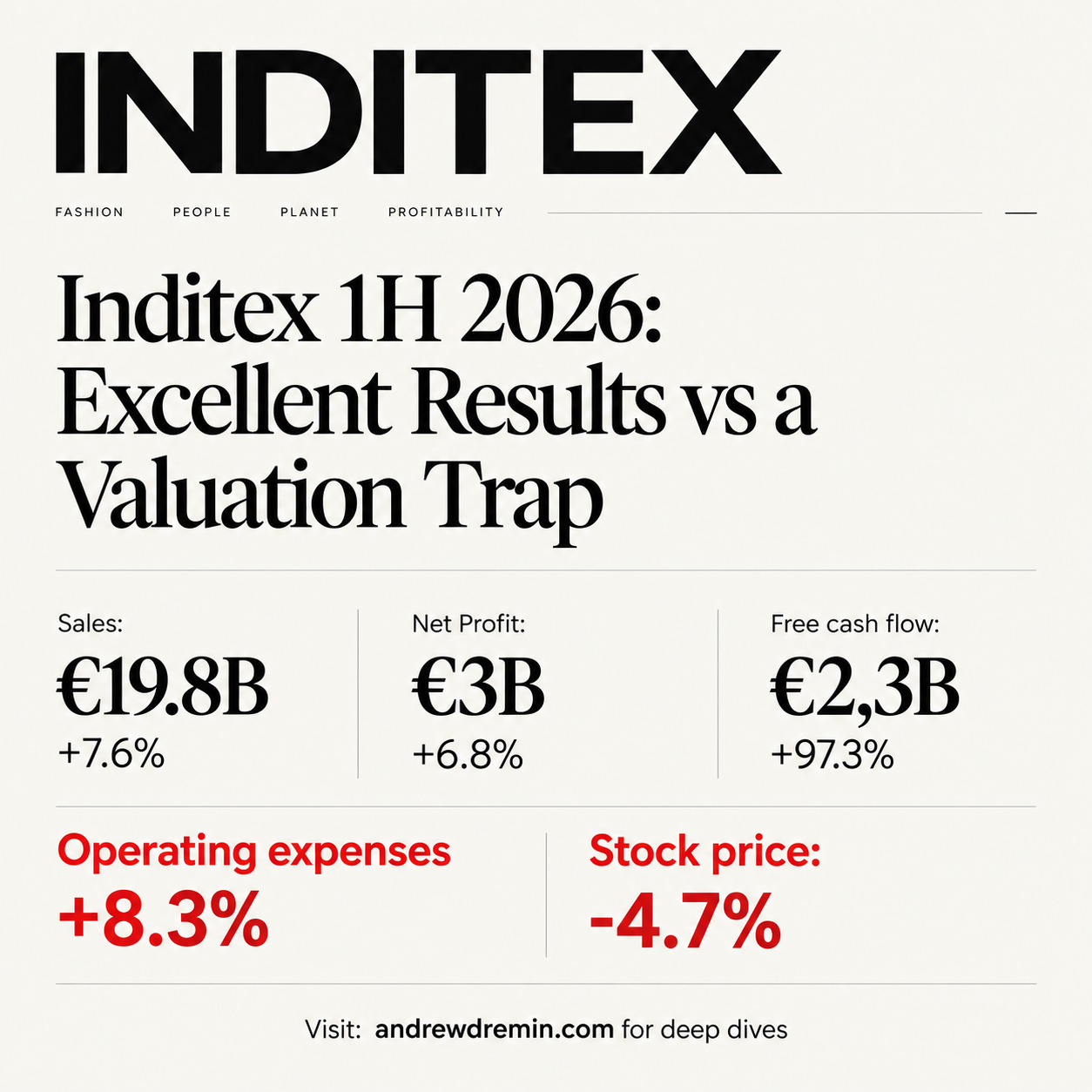
ZARA’s parent company, Inditex, just released its 1H 2026 results. On the surface, the numbers look very strong. Sales hit €19.8 billion, representing a 7.6% increase, or 9.2% in constant currency.
Looking precisely at the data provided, we see the net profit reached €3 billion. This is a 6.8% increase year-over-year. Free cash flow surged 97.3% to €2.3 billion. The company is currently sitting on a massive €10.4 billion cash pile.
So, what did the market do? The stock price slid 4.7% by lunchtime.
A colleague asked me a simple question: “Sales grew by 7.6%. The company is highly profitable. Why is the board nervous, and why did investors sell?”
The answer is straightforward. It is the valuation trap.
The Valuation Trap in the Fashion Industry
Inditex trades at a price-to-earnings (P/E) multiple of around 26. When a company trades at 26 times earnings, equity markets do not just want good results. They demand total perfection.
A high valuation means investors are paying a premium for future growth. If any metric signals that future growth might stall, the stock drops. The gross margin did improve to 58.7%, which shows they are making good money on the clothes they actually sell. However, the problem lies lower on the balance sheet.
Operating expenses jumped 8.3%.
Why Operating Expenses Matter More Than Revenue
The 8.3% increase in operating expenses outpaced the 7.6% growth in sales. This is a red flag for institutional investors. Top-line revenue growth without strict cost control is just busywork. You are moving more volume but keeping less of the margin from that extra volume.
We are operating in a high-interest-rate environment. The cost of capital is expensive. Investors can get a 4% to 5% return on risk-free government bonds. Therefore, they do not tolerate cost creep in equities, even from best-in-class operators. If a company cannot control its overhead, investors will move their money elsewhere.
Retail Market Trends: Visible Cracks in the System
Inditex is not operating in a vacuum. Across the European retail and apparel supply chain, the cracks are highly visible. Other companies are struggling to maintain their margins and customer bases.
- Department Stores: John Lewis & Partners saw their losses widen to £124 million. Foot traffic softened because consumers are spending less time browsing large department stores.
- Fast Fashion Competitors: Primark is currently testing home delivery. Historically, Primark refused to offer delivery because their low price points could not absorb the shipping costs. They are testing it now just to defend their transaction volumes.
- FMCG Market Challenges: Fast-Moving Consumer Goods (FMCG) brands are losing ground. Brands that charge double the price of supermarket private labels are watching shoppers walk away. Consumers are actively trading down to cheaper alternatives to offset inflation.
Inditex is running circles around most of these competitors. But the Inditex board knows the old fast fashion strategy playbook is dead.
Global Retail Strategy: Mega-Flagships Over Small Shops
To understand the Inditex strategy, look at their capital expenditure. Over the last five years, they shut down 1,200 smaller stores. They did this to free up capital.
They channeled that money into a €2.5 billion capex push. Instead of hundreds of small shops, they are building high-tech mega-flagships in prime global locations like Miami and São Paulo.
The strategy is clear:
- The total store count dropped.
- Yet, the total commercial floor space grew by 5%.
Supply Chain Speed and Capital Allocation
These mega-stores serve a dual purpose. They act as traditional retail spaces, but they also function as localized fulfillment centers for online orders. By centralizing inventory into larger hubs, Inditex improves its supply chain optimization and speed.
They use advanced RFID tracking to know exactly where every item is located. This requires heavy initial investment, which partly explains the high capital expenditure and the rising operating costs. Staffing and running these massive locations costs more in wages and utilities.
4 Core Rules for Retail Executives in 2026
The market sent a clear signal with the Inditex stock drop. Every retail and FMCG executive must pay attention to these four rules.
- Opex Cannot Outrun Revenue: If your overhead grows faster than your sales, your valuation takes the hit. There are no exceptions. A record top line will never hide an expanding cost base from institutional investors.
- Space Productivity Beats Store Count: Cut your secondary locations. They drain resources. Concentrate your capital where revenue density is the highest. A smaller network of high-volume, highly efficient stores is better than a massive footprint of average locations.
- Pricing Power is Gone: You can no longer pass wage and freight inflation directly onto shoppers. Consumers have reached their limit. Future margin gains have to come from supply chain speed, automation, and inventory turnover. You cannot rely on higher ticket prices.
- Liquidity is a Buffer, Not an Excuse: A strong balance sheet is good for survival, but it will not protect your stock price if operating efficiency slips. Inditex has a €10.4 billion cash pile. The market still punished them for the operating expense miss.
Conclusion: A Reality Check for Fast Fashion Earnings
Did the market overreact to the Inditex financial results 2026?
Some analysts assume the market was too harsh. I disagree. This is not an overreaction. This is a long-overdue reality check for the retail sector.
Inditex is an excellent company. The €3 billion net profit proves they know how to sell clothes. However, the math of equity markets is absolute. If a company is priced for perfection, it must deliver perfection. When costs grow faster than revenue, the hypothesis of infinite, highly profitable growth breaks down. The market adjusted the price accordingly. Efficiency is now the only metric that matters.
FAQ
What is a valuation trap in stock analysis?
A valuation trap occurs when a company’s stock trades at a very high multiple (like a P/E of 26). The high price assumes flawless future performance. If the company shows even a minor flaw—like rising costs—the stock price drops sharply, trapping investors who bought at the top.
Why did Inditex close 1,200 stores?
Inditex closed smaller, less profitable stores to consolidate their capital. They used the savings to open larger, high-tech mega-flagships in prime locations. This increases their total retail space while reducing the number of individual leases they have to manage.
What is the difference between revenue and operating expenses (opex)?
Revenue is the total amount of money brought in by sales. Operating expenses are the costs required to run the business, such as wages, rent, utilities, and logistics. For a company to increase its profitability, revenue must grow faster than operating expenses.
Why are FMCG brands losing customers to private labels?
Due to inflation, consumers are highly price-sensitive. FMCG brands often charge a premium for their brand name. Supermarket private labels offer similar products at a much lower price. Shoppers are abandoning brand loyalty to save money.
Will large retailers reach a hard limit on optimizing supply chains to offset labor costs?
Yes. Physical and capital limits exist. You can only automate a warehouse or consolidate routes so much before the return on investment for new robotics turns negative. Labor costs are structural. Once the basic optimizations are exhausted, retailers face a hard choice: accept lower margins or pass the costs directly to consumers.
Related posts:
 GLP-1 Retail Impact: How Weight-Loss Drugs Are Shrinking Supermarket Sales
 The Illusion of High-Volume Promotions: Why a 33% Uplift Destroys Margins
 Testing the Limits of Brand Power: Nivea in an Inflated Economy
 The €100 Billion Milestone: Inside the Rise of Europe’s Silent Retail Giant
 The flat soda tax: Coca-Cola pricing strategy
 Spain Grocery retail market share July 2026
Leave a Reply