
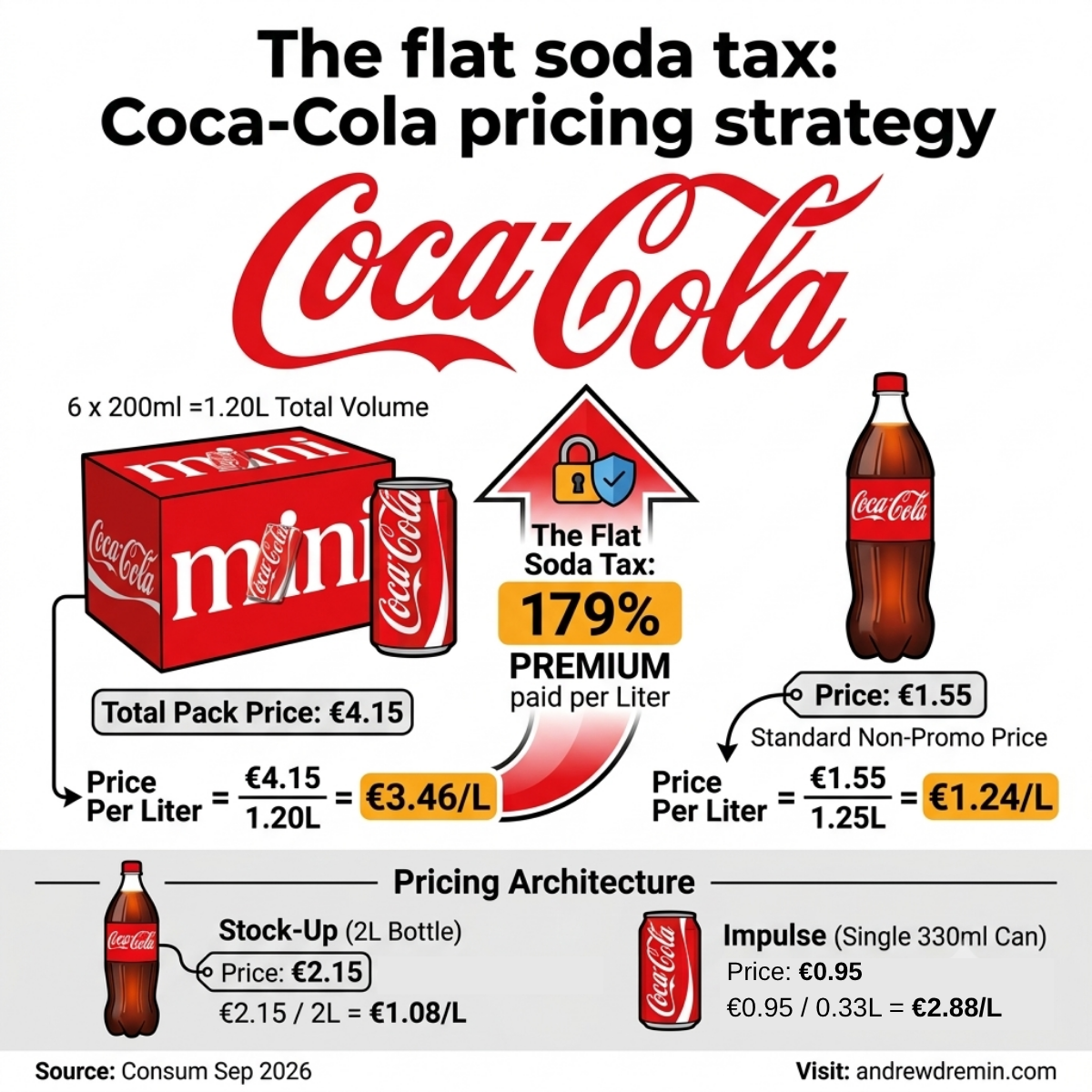
€3.46 per liter versus €1.24 per liter. That is a 179% markup. These figures raise important questions about the Coca-cola pricing strategy 2026 and what drives such differences, particularly concerning mini can pricing.
Shoppers in Spanish supermarkets pay this price difference every day when choosing between a 6-pack of 200ml Coca-Cola mini cans and a standard 1.25L plastic PET bottle.
| Packaging Format | Total Volume | Shelf Price | Unit Price (€/L) |
|---|---|---|---|
| 2L Bottle Stock-Up | 2.00 L | €2.15 | €1.08 / L |
| 1.25L Bottle Standard Non-Promo | 1.25 L | €1.55 | €1.24 / L |
| Single 330ml Can Impulse | 0.33 L | €0.95 | €2.88 / L |
| 6 x 200ml Mini Cans Premium Multipack | 1.20 L | €4.15 |
€3.46 / L +179% PREMIUM VS 1.25L |
| Source: Consum Sep 2026 | |||
The shopper pays €2.60 more at checkout for 50ml less beverage.
This is not a trick, and it is not simple price gouging. It is a calculated execution of Price Pack Architecture (PPA) meeting real consumer behavior.
The Shopper Logic: Paying for “Carbonation Insurance”
Why does a rational person pay nearly triple the price per liter for the exact same beverage formula?
The decision comes down to the fear of waste and shifting household sizes.
| Buy 1.25L Bottle for €1.55 | Buy 6x200ml Cans for €4.15 |
|---|---|
|
Day 1: Fresh (Good experience)
Day 3: Flat Soda (30-40% poured down drain) |
6 separate, hermetically sealed servings
100% carbonated on demand |
| Effective Cost Rises + Frustration | Zero product waste |
- The carbonation decay problem: A 1.25L bottle opened on Monday loses its carbon dioxide by Wednesday. In a single-person or two-person household, the last 400ml often ends up in the sink.
- The illusion of savings: A shopper feels worse about pouring €0.50 worth of flat soda down the drain than spending €4.15 upfront on cans they know will stay fresh.
- Portion control and health limits: Modern shoppers want strict portion limits. A 200ml aluminum can sets a hard stop at roughly 84 calories. A large plastic bottle encourages over-pouring and passive consumption.
- Cold storage speed: A thin aluminum can chills in an icebox or refrigerator in under twenty minutes. A thick 1.25L plastic bottle takes hours to reach the same drinking temperature.
The customer is not just buying carbonated water, sugar, and syrup. They are buying an insurance policy against flat drinks, warm soda, and personal lack of dietary discipline.
Price Pack Architecture: The Impulse Myth vs. Pantry Reality
In retail category management, manufacturers and buyers often misclassify the 200ml mini can multipack as an impulse product.
It is not an impulse purchase.
| Feature | True Impulse Format | Ambient Multipack (Mini Cans) |
|---|---|---|
| Typical SKU | Single 250ml / 330ml Chilled Can | Cardboard-wrapped 6x200ml Pack |
| Placement | Front-end Cooler / Checkout Queue | Center Ambient Beverage Aisle |
| Basket Intent | Immediate consumption on-the-go | Planned home pantry stock-up |
| Friction Point | Low cash ticket (< €1.20) | High cash ticket (€4.00 – €5.00) |
| Temperature Requirement | Chilled / Drink Now | Room temperature / Store at home |
True impulse products have a low absolute cash price and sit cold near the checkout for instant consumption.
A glued cardboard box containing six ambient cans sits on a center-store shelf. The customer cannot open it in their car without a disposal problem for the packaging, and the drink is warm.
FMCG pricing strategy leverages this format to drive revenue growth management (RGM) by capturing premium household spend without alienating price-sensitive shoppers who stick to large bottles.
The Industrial Cost Reality Behind Small Beverage Packaging
The retail price difference is not pure profit margin. The industrial beverage packaging costs per liter to package small aluminum volumes are significantly higher than blowing large plastic bottles.
- Primary packaging costs: Aluminum is far more expensive than polyethylene terephthalate (PET) plastic. A 6-pack uses six aluminum can bodies, six pull-tab lids, and a secondary printed cardboard sleeve. The 1.25L format uses a single plastic preform, one plastic cap, and one thin film label.
- Filling line efficiency and throughput: Bottling lines measure output in units per minute. Running 600 mini cans fills only 120 liters of product. Running 600 standard 1.25L bottles fills 750 liters of product in the same operational window.
- Secondary packaging and handling: Wrapping six individual mini cans in cardboard requires dedicated machinery, extra glue, and higher maintenance downtime than bundle-wrapping PET bottles with clear heat-shrink film.
- Logistics and pallet cube utilization: Cans pack tightly, but the ratio of packaging weight to liquid payload is higher on mini formats. Retailers and distributors move more dead weight in metal and cardboard per liter delivered.
Even with these manufacturing realities, brand gross margins on mini cans remain substantially higher than on bulk PET formats.
Merchandising Mistakes: How Shelf Placement Kills Margin
The biggest operational mistake happens on the retail shelf planogram, highlighting a critical flaw in retail merchandising strategy.
When a category manager places the €4.15 mini can pack directly alongside the €1.55 bottle of the same brand, they create unnecessary shopper friction.
| POOR PLANOGRAM (Direct Price Conflict) | OPTIMIZED PLANOGRAM (Segmentation by Mission) |
|---|---|
|
1.25L Bottle
€1.55 | €1.24/L
⟷
6x200ml Cans
€4.15 | €3.46/L
|
Soft Drinks Bulk /
Family Table 2L / 1.25L PET Formats
Premium Mixers /
Single Serve 6x200ml Mini Cans &
Glass Packs |
Under European Union labeling regulations, retailers must display the unit price per liter (€/L) on the shelf edge label. When a shopper sees €1.24/L right next to €3.46/L, the massive 179% difference creates cognitive dissonance:
- Destroys the store’s value perception: The customer feels the retailer is trying to extract unfair margins on small formats.
- Slows down the buying decision: The shopper stops to calculate value instead of grabbing the SKU that fits their lifestyle.
- Forces down-trading: Price-conscious consumers who wanted small portions may default to the cheaper bottle, only to waste half of it at home and feel disappointed with the brand experience.
Action Plan for FMCG Brands and Supermarket Retailers
To protect category margin while keeping price-sensitive customers happy, brands and retailers must align formats with distinct shopper missions.
Tactical Playbook for FMCG Beverage Brands
- Redefine the consumption mission: Market the 200ml can as a dedicated single-serve experience or a premium mixer for spirits, rather than a generic soda alternative.
- Differentiate packaging visuals: Use distinct matte finishes, special cardboard graphics, or seasonal themes for mini formats so they look like a distinct premium line rather than a smaller version of a commodity bottle.
- Negotiate single-can distribution: If you want true impulse sales, build distribution for loose, chilled 200ml/250ml cans in high-traffic front-of-store coolers with a clear sub-€1.00 single-item price.
- Control multipack volume tiers: Test 4-packs and 8-packs to hit psychological price thresholds (€2.99 or €4.99) depending on regional inflation and grocery basket pressure.
Tactical Playbook for Supermarket Retailers
- Separate shelf adjacencies: Move mini can multipacks away from bulk family PET bottles. Group them near premium tonics, cocktail mixers, or premium single-serve treats.
- Utilize secondary placements: Display mini can 6-packs on endcaps paired with snacks, deli items, or premium spirits (e.g., rum, gin, or whiskey) where the shopper thinks about portion-controlled drink mixing.
- Protect the Key Value Item (KVI) baseline: Keep the standard 330ml can and 1.5L/2L bottle prices competitive to preserve your store’s overall low-price image, while capturing full margin on mini formats.
- Clear out grab-and-go coolers: Remove ambient multipacks from high-cost front-end refrigeration space. Reserve cold space exclusively for single, chilled drinks meant for immediate consumption.
Frequently Asked Questions (FAQ)
What is Price Pack Architecture (PPA) in FMCG?
Why do beverage companies produce 200ml mini cans?
Why is the unit price (€/L) so much higher on small cans than large bottles?
Does the large price gap between cans and bottles hurt sales?
Related posts:
 The Illusion of the iPhone Index: What Viral Charts Miss About Consumer Purchasing Power
 GLP-1 Retail Market Trends 2026: Data, Forecasts & Consumer Shifts
 IMD World Competitiveness Ranking 2026: Global Sourcing Shifts and Commercial Reality
 Emerging Megacities: FMCG Retail Trends and Consumer Shifts by 2050
 Spain Grocery Market Share 2026: Why Giants Flatline
 Aldi vs Tesco Sainsbury Loyalty Schemes: 2026 Analysis
Leave a Reply