
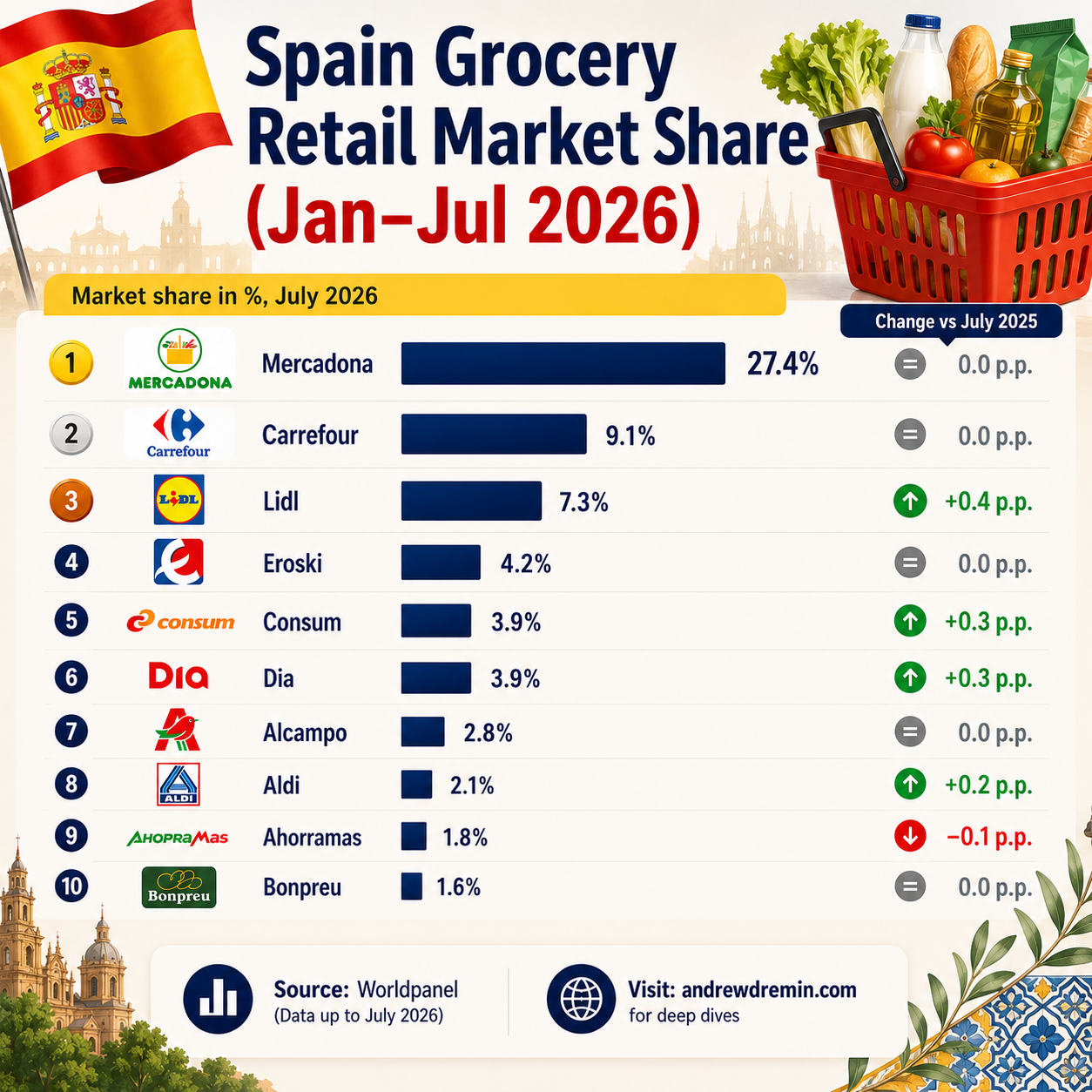
Mercadona controls 27.4% of the Spanish grocery market. More than one out of every four euros spent on food, cleaning products, and personal care goes through their cash registers.
Across the first seven months of 2026, their market share growth was 0.0 percentage points.
Spain Grocery Retail Market Share
Jan–Jul 2026
| # | Retailer | Market Share (Jul 2026) | Change vs Jul 2025 |
|---|---|---|---|
| 1 | Mercadona | = 0.0 p.p. | |
| 2 | Carrefour | = 0.0 p.p. | |
| 3 | Lidl | ▲ +0.4 p.p. | |
| 4 | Eroski | = 0.0 p.p. | |
| 5 | Consum | ▲ +0.3 p.p. | |
| 6 | Dia | ▲ +0.3 p.p. | |
| 7 | Alcampo | = 0.0 p.p. | |
| 8 | Aldi | ▲ +0.2 p.p. | |
| 9 | Ahorramas | ▼ -0.1 p.p. | |
| 10 | Bonpreu | = 0.0 p.p. |
For an operational machine built on constant expansion, zero growth over seven straight months is a clear signal. This is not a simple seasonal dip. It shows structural limits in the Spanish retail landscape, deliberate capital reallocation, and a massive shift in how local consumers spend money.
Why Mercadona Hit the 27% Saturation Wall in Spain
Controlling over a quarter of a major European grocery sector without acquiring direct rivals is historically rare.
The European Grocery Saturation Threshold
In modern European retail, single-chain organic growth almost always hits a barrier between 26% and 29%:
- United Kingdom: Tesco peaked near 30% before settling into a long-term plateau around 27% to 28%.
- France: E.Leclerc runs close to 24%, facing fierce pushback from Carrefour, Intermarché, and Système U.
- Belgium: Colruyt holds around 30% and has to fight daily price wars to defend it.
Once a chain hits this ceiling, every additional 0.1% of market share costs significantly more capital. You can no longer open a new supermarket in an untouched neighborhood. Every new store risks cannibalizing an existing one down the road.
Regional Supermarkets Defend Their Home Turf
Spain is not a unified retail market. It is a collection of regional bastions where local chains hold deep loyalty, superior fresh supply chains, and prime commercial real estate:
- Catalonia: Bonpreu and Esclat dominate local sentiment and fresh categories.
- Basque Country and Northern Spain: Eroski and BM Supermercados (Grupo Uvesco) maintain strong customer bases.
- Galicia: Gadis and Froiz control urban and suburban centers.
- Levante / Valencian Community: Consum runs an aggressive cooperative model right in Mercadona’s backyard.
These regional grocers do not compete on massive international buying scale. They win on fresh fish, local fruit, regional meat, and customer service counters. Mercadona’s centralized, packaged model struggles to pull traditional shoppers away from these regional specialists.
Capex Shift: How Portugal Expansion Affects Mercadona Spain
Mercadona’s capital expenditure (Capex) priorities changed. The company is no longer pouring money into increasing net retail surface inside Spain.
The Portugal Factor (Irmadona)
Juan Roig’s primary growth engine is now Portugal. Operating under the local brand Irmadona, the company has spent hundreds of millions of euros building:
- Large regional logistics hubs (such as the Alverca-Ribatejo platform near Lisbon).
- A dense network of stores expanding from the Porto district down through Lisbon and Setúbal.
- Customized local supply chains to cater to Portuguese tastes instead of simply shipping Spanish SKUs.
Every euro spent building out Portuguese infrastructure is a euro not spent opening new stores in Spain.
Store Restructuring: Modernization Over Expansion
Inside Spain, Mercadona’s footprint strategy focuses on efficiency rather than unit growth:
- Closing Small Legacy Units: Shutting down older, cramped urban stores that lack parking or space for prepared food sections.
- Upgrading to Tienda Eficiente (Store 9): Expanding store footprint, widening aisles, adding energy-efficient refrigeration, and installing large “Listo para Comer” (Ready-to-Eat) kitchens.
- Net Space Stagnation: While existing locations are becoming more profitable per square meter, the total net commercial area of Mercadona in Spain has leveled off.
Spanish Grocery Shopping Trends: The End of the Single Weekly Basket
Inflation between 2022 and 2025 permanently changed consumer behavior in Spain. The traditional habit of doing one massive weekly grocery run at a single supermarket has collapsed.
Spanish households now practice basket splitting. They divide their weekly food budget across three to four different retail concepts to maximize savings and quality.
| Retailer Type | Retailer Examples | What Consumers Buy |
|---|---|---|
| Hard Discounters | Lidl, Aldi | Pantry staples, nuts, dairy, middle-aisle |
| Proximity & Top-up | Dia | Mid-week essentials, beverages, emergency |
| Fresh Specialists | Consum, Bonpreu, Traditional Markets | Fresh meat, fish, local produce |
| One-Stop Destination | Mercadona, Carrefour | Packaged goods, cleaning, personal care |
Jan–Jul 2026 Market Share Winners in Spain
The data from the first seven months of 2026 shows who captured the fragmented spending:
- Lidl (7.3%, +0.4 p.p.): Expanding aggressively with urban store formats and high-traffic weekly promotions.
- Consum (3.9%, +0.3 p.p.): Pulling customers through superior fresh meat and delicatessen counters alongside a popular member-rebate loyalty program.
- Dia (3.9%, +0.3 p.p.): Reaping the rewards of its post-restructuring turnaround.
- Aldi (2.1%, +0.2 p.p.): Steadily building stores in high-income urban corridors.
Dia and the Power of Proximity Shopping
Dia’s gain (+0.3 p.p.) is an important market indicator. After selling off its large hypermarkets and Clarel cosmetics stores, Dia rebuilt its brand around one core advantage: being 300 meters from the consumer’s front door.
When shoppers only need eggs, milk, and bread on a Tuesday evening, they do not get in a car to drive to an edge-of-town Mercadona. They walk to Dia. Proximity and fast checkout are actively chipping away at destination retail volume.
FMCG Brands Fight Back Against Hacendado and Private Labels
Mercadona’s business model depends heavily on its private-label brands:
- Hacendado (Food and Beverage)
- Bosque Verde (Home Care and Cleaning)
- Deliplus (Personal Care and Cosmetics)
Private labels represent over 75% of Mercadona’s assortment. For years, major Fast-Moving Consumer Goods (FMCG) manufacturer brands were squeezed out or relegated to bottom shelves with zero price support.
Carrefour and the Multi-Brand Promotion War
Leading FMCG manufacturers (Nestlé, Danone, Campofrío, Heineken, Unilever, P&G) changed their strategy. Instead of begging Mercadona for shelf space, they partnered with multi-brand retailers like Carrefour and Alcampo.
- Massive promotional funding (3×2, 2nd unit at -70%).
- Exclusive loyalty app vouchers (Mi Carrefour accumulation).
- Highlighting product innovation and premium recipe upgrades.
- Sponsoring retail-media ads inside competitor apps.
This brand-funded promotional push allowed Carrefour to stabilize its market share at 9.6% (0.0 p.p. loss) after years of losing volume to discounters. When manufacturer brands run aggressive promotions in Carrefour, the price gap between a name-brand product and Mercadona’s Hacendado narrows enough to win back middle-class shoppers.
Strategic Takeaways for Retailers and Food Manufacturers
The 2026 plateau of Spain’s grocery market leader provides direct operational lessons for the entire consumer goods sector.
For FMCG Manufacturers and Food Processors
- Stop chasing Mercadona distribution: If you are not an integrated Totaler supplier, Mercadona offers limited shelf space. Your volume growth for the next three years sits in regional chains (Consum, Bonpreu, Eroski, Gadis) and discounters.
- Fund targeted trade promotions: Shoppers are price-sensitive. Use 2nd-unit discounts and app-based loyalty cashbacks inside multi-brand retailers to keep your price close to private-label alternatives.
- Double down on fresh innovation: Private labels mimic standard packaged SKUs quickly. They are slower to copy specialized local items, functional health formulations, and premium fresh items.
For Supermarket Operators and Competitors
- Compete on proximity or fresh counters: You cannot out-scale Mercadona on dry packaged goods. Win where their centralized model is weakest: personalized butcher/fish counters, localized sourcing, and compact downtown footprints.
- Fix your loyalty mechanics: Spanish consumers actively switch stores for tangible rewards. Direct cash-back balances (like Dia’s Club Dia or Consum’s monthly checks) drive weekly foot traffic better than vague points systems.
What is Mercadona’s current market share in Spain?
As of mid-2026, Mercadona holds 27.4% of the Spanish grocery market. It remains the dominant grocery retailer in Spain by a wide margin over second-place Carrefour (9.6%) and third-place Lidl (7.3%).
Why did Mercadona stop growing its market share in 2026?
Mercadona’s market share growth reached 0.0 p.p. in early 2026 due to three main factors: high market saturation near the 27% ceiling, capital expenditure shifting toward their Portugal expansion, and consumer basket splitting toward discounters (Lidl, Aldi) and proximity stores (Dia).
What does “basket splitting” mean in supermarket retail?
Basket splitting is a shopping habit where consumers no longer buy all their groceries at one supermarket. Instead, they divide purchases: buying dry staples at hard discounters, fresh meat and vegetables at regional specialists, and daily essentials at local proximity stores.
How is Portugal important to Mercadona’s long-term business?
Portugal (operating under the name Irmadona) represents Mercadona’s primary international expansion. Because the Spanish market is saturated, Portugal provides the company with room for new store openings and long-term revenue growth.
Why are regional supermarkets so strong in Spain?
Regional chains like Consum, Bonpreu, Eroski, and Gadis have deep roots in their respective autonomous communities. They hold prime urban real estate, maintain direct relationships with local agricultural producers, and offer traditional staffed fresh counters (butcher, fishmonger, charcuterie) that large discount chains struggle to match.
Related posts:
 Spain Grocery Market Share 2026: Why Giants Flatline
 Emerging Megacities: FMCG Retail Trends and Consumer Shifts by 2050
 Seasonal Retail Inventory Management: 85/15 Buffer Model
 Aldi vs Tesco Sainsbury Loyalty Schemes: 2026 Analysis
 2030 Global GDP Forecast: The $6.2 Trillion Illusion
 National Brands vs Private Labels in Europe: The Reality Behind the Data
Leave a Reply