
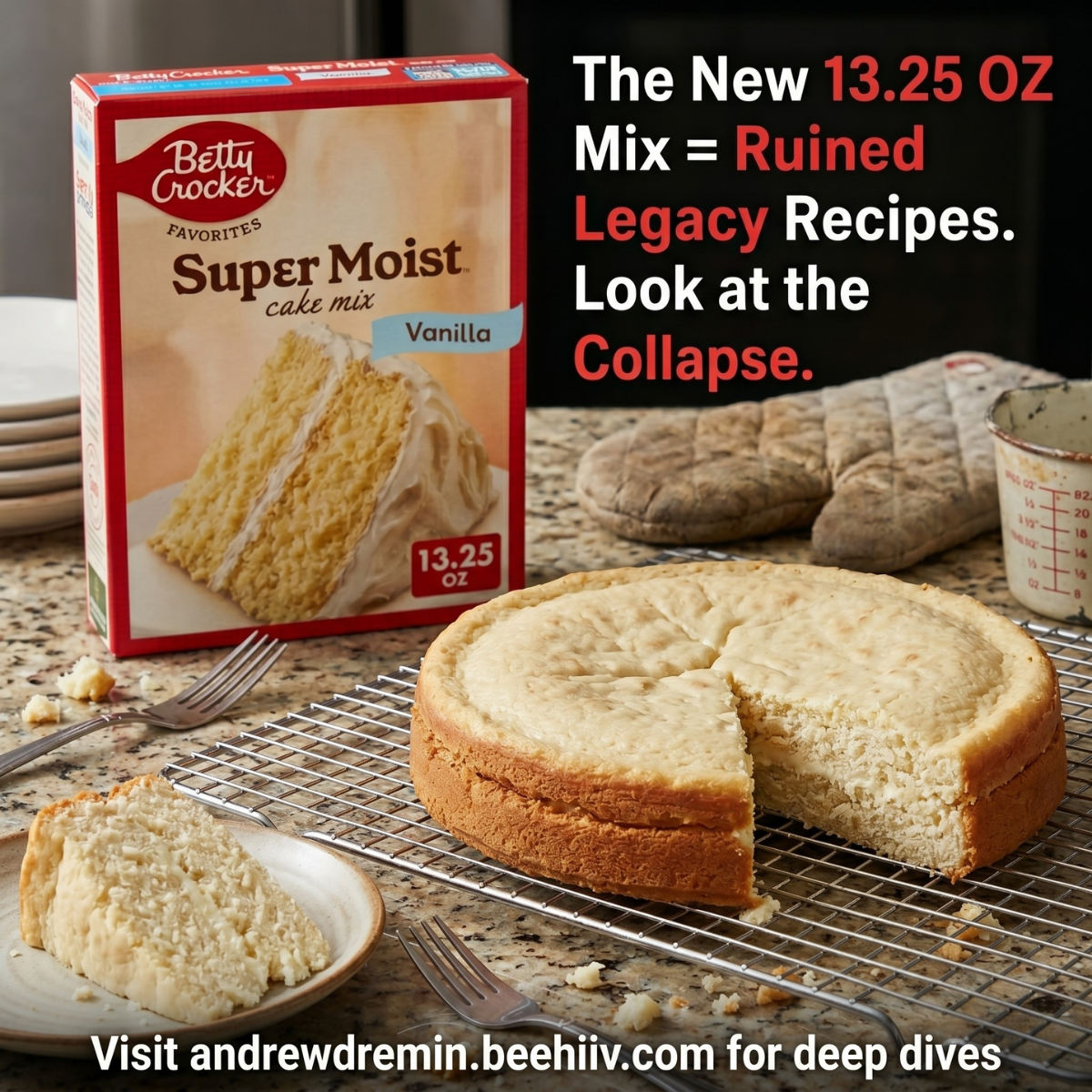
13.25 ounces. That is all that is left of a standard Betty Crocker cake mix box. This change is just one example of US CPG shrinkflation market trends affecting everyday products.
For decades, the standard weight for a box of cake mix was 18.25 ounces. Over the years, food manufacturers reduced that weight to 16.5 ounces, then to 15.25 ounces, and finally to 13.25 ounces. That represents a total weight reduction of nearly 28 percent.
When General Mills and other major consumer packaged goods (CPG) companies reduced package sizes, they did not just shrink the cardboard box. They broke the basic chemistry of home baking.
The Science Behind Broken Recipes
Baking is exact chemistry, not flexible cooking. In cooking, you can add water or spices to taste. In baking, strict chemical ratios govern structure, rise, and moisture.
For over forty years, popular cookbooks, family recipes, and community hacks relied on one constant: an 18.25-ounce box of cake mix. Classic baking references built hundreds of recipes around adding eggs, sour cream, and oil to that exact weight base.
When manufacturers cut five ounces of dry mix over time while keeping liquid requirements unchanged on legacy recipes, three structural failures occurred:
- Reduced Cupcake Yield: Standard mixes that used to fill 24 cupcake liners now yield only 18 to 20 cupcakes.
- Formula Imbalance: Adding three eggs and a half cup of oil to 13.25 ounces of mix creates an overly wet, thin batter.
- Texture Failure: The baked cake often turns out dense, flat, and gummy at the bottom.
The Chemical Fix That Backfired
To make a smaller package fill a standard cake pan, food engineers altered the ingredient ratios inside the box. They increased the reliance on heavy chemical leaveners, including sodium acid pyrophosphate, monocalcium phosphate, and sodium bicarbonate (baking soda).
The objective was straightforward: force a smaller volume of dry batter to expand higher in the oven so the finished cake looks full-sized.
However, the physics failed in home ovens:
- Forced Expansion: High concentrations of chemical leaveners produce rapid carbon dioxide gas early in the baking process, creating oversized, fragile air pockets.
- Structural Collapse: The reduced amount of flour provides less gluten and starch matrix to support those large air bubbles. As the cake cools, the trapped gas contracts and the cake collapses into a flat, heavy mass.
- Chemical Aftertaste: Excess chemical leaveners do not fully react during baking, leaving a distinct metallic or soapy taste on the tongue.
Consumer Response: From Hacks to Brand Defection
Consumers noticed the performance drop quickly. When trusted recipes failed, home bakers turned to online forums, Reddit communities, and food blogs to figure out what happened.
Baking communities created manual fixes called “cake mix extenders”:
- Adding 1/2 cup of all-purpose flour
- Adding 2 to 3 tablespoons of granulated sugar
- Adding 1/4 teaspoon of baking powder
- Adjusting water and oil by tablespoon increments
This reaction exposes a critical product flaw. Consumers buy boxed cake mix for speed and reliability. If a customer must measure flour, sugar, and baking powder from scratch to repair a commercial product, the product loses its core value proposition: convenience.
Once convenience disappears, consumer behavior shifts in two ways:
- Switching to Store Brands: Shoppers buy store-brand mixes that deliver the same reduced performance at a lower price.
- Baking from Scratch: Shoppers buy raw ingredients and bypass the commercial cake mix aisle entirely.
Strategic Lessons for FMCG Executives
Brand managers often view shrinkflation purely as a financial tool to protect profit margins against rising ingredient costs. While this tactic works for standalone snacks like potato chips, it fails when a product acts as an active component in a functional process.
The Utility Floor
Every physical product has a utility threshold. Once a size cut breaks how the product works, shrinkflation stops saving margins and starts destroying brand equity.
Real-World Performance
Laboratory test kitchens do not reflect decades of legacy use across millions of home kitchens. If a product fails during family events or holidays, customer trust drops permanently.
The Convenience Standard
Convenience items cannot demand extra labor. Forcing customers to perform chemical repairs at home destroys brand loyalty.
Decision Framework: Managing Cost Pressures
When raw material costs rise, executive teams face three distinct choices:
| Strategy | Margin Impact | Equity Risk | Consumer Perception |
| Stealth Shrinkflation | High protection (Short-term) | High risk | Deceptive; drives customer defection |
| Transparent Price Increase | Moderate protection | Low risk | Honest; preserves product utility |
| Dual Product Tiers | High protection (Long-term) | Moderate risk | Clear choice between basic and classic sizes |
Reducing package weight while altering chemical formulas trades long-term brand equity for short-term financial targets. When a product loses its core function, a stable shelf price will not stop customer defection.
When faced with rising input costs, would you choose to raise the shelf price transparently or reduce product weight past its functional limit?
Related posts:
 The Doubt Economy: Why Proof Beats Hype in Retail
 Spain reached 19th place on the 2026 HelloSafe Prosperity Index
 The battle for US grocery market.
 Футбольный клуб как торговый центр
 The Billion-Dollar Illusion: How a Fake Movie Parade Transformed Global Retail and Tourism
 Global Beer Market Trends 2026: The $41B Zero-Alcohol Shift
Leave a Reply