
The 2026 FIFA World Cup was the biggest sporting event in history. It was also a massive battle between global sportswear brands. There are many adidas world cup strategy lessons 2026 can teach businesses and marketers about competition on the world stage.
When the final whistle blew on July 19 at New York New Jersey Stadium, Spain defeated Argentina 1–0. But the biggest commercial winner of the day was not a country. It was Adidas.
Adidas did not just sponsor the tournament. They dominated the retail floor, outsmarted their primary competitor Nike, and rewrote the rules of sports marketing.
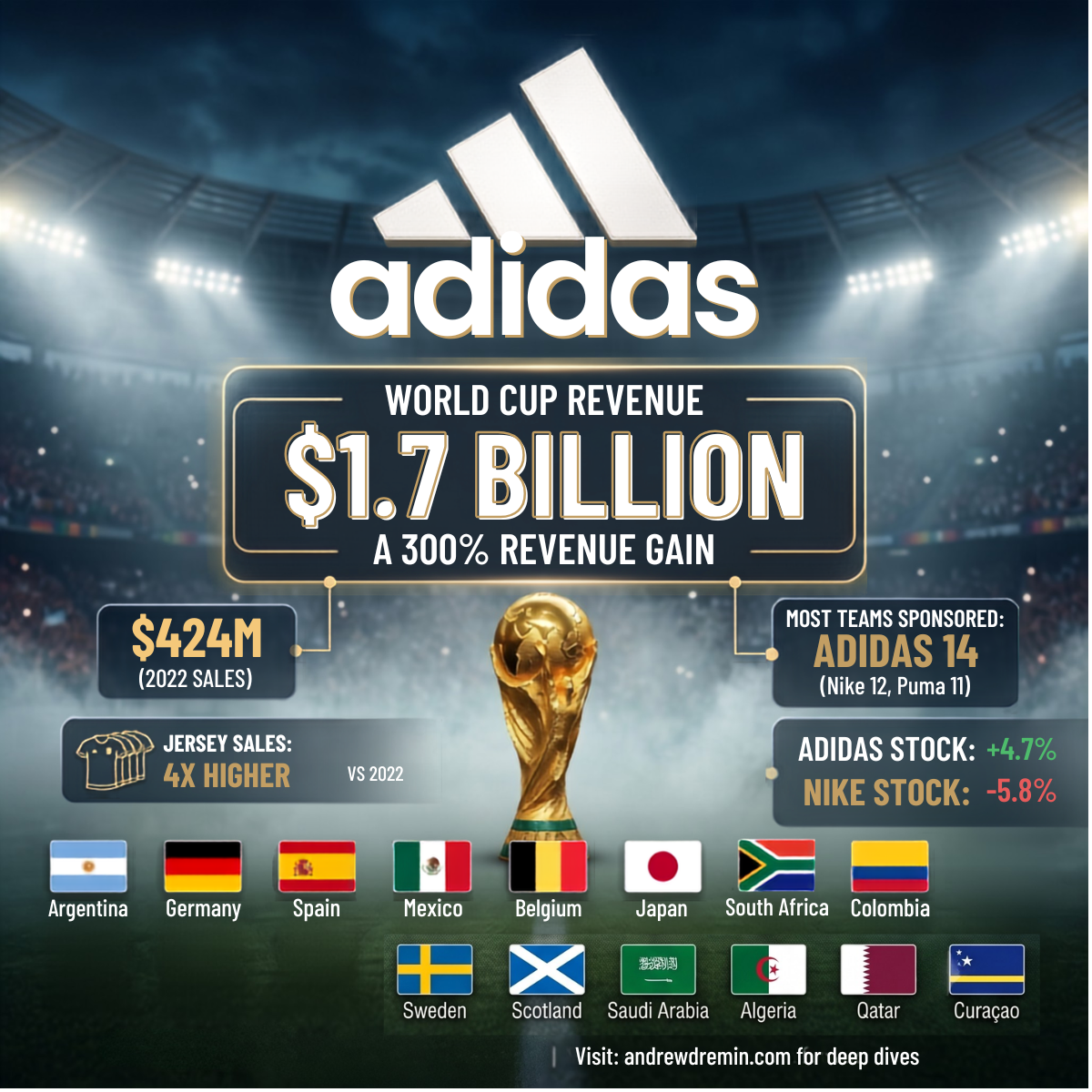
Before the tournament started, Adidas leadership under Chief Executive Officer Björn Gulden set a conservative sales goal of over €1.0 billion. By the end of the tournament, Adidas raised its guidance to roughly €1.5 billion ($1.7 billion) in event-related revenue. They sold four times as many football jerseys and twice as many official match balls as they did during the 2022 World Cup in Qatar. In 2022, Adidas made $424 million from the World Cup. Making $1.7 billion in 2026 represents a 300% surge in top-line sales.
Meanwhile, Nike spent millions of dollars on traditional linear television ads, only to suffer stockouts, mid-tournament team eliminations, and a drop in stock price.
This report breaks down the financial data, marketing numbers, supply chain struggles, and consumer behavior behind the 2026 World Cup. It offers clear, actionable lessons for retail and FMCG (Fast-Moving Consumer Goods) leaders looking to turn cultural trends into bottom-line profits.
Adidas Business Model: How the Company Makes Money
To evaluate Adidas as a business, skip the marketing slogans. Look at two factors: what they sell and where they sell it.
- Performance (Football, Running, Training): The foundation of the brand. Elite sports adoption gives Adidas technical credibility. Football (soccer) is the core halo category.
- Lifestyle & Originals (Samba, Gazelle, Spezial, Campus): The profit driver. Retro footwear carries high margins and cultural hype, though reliance on fast-moving fashion trends carries risk.
- Wholesale Channel (~55–58% of Revenue): Adidas partners with multi-brand retailers like Foot Locker, JD Sports, and independent soccer shops to secure massive physical reach and inventory clearance.
- Direct-to-Consumer Channel (~42–45% of Revenue): Adidas uses company-owned retail hubs and its e-commerce platform for full-price sales, limited edition drops, and direct consumer data collection.
Financial and Operational Snapshot
| Metric | Normal Target | Operational Reality |
| Gross Margin | ~50% – 52% | Stable when full-price sales hold and discounting is minimized. |
| Operating Margin (EBIT) | 8% – 10% | Rebuilding after the 2022–2023 Yeezy inventory write-offs. |
| Channel Mix | 57% Wholesale / 43% D2C | Balanced split to control customer acquisition costs (CAC). |
| Regional Priorities | Europe, LatAm, US, China | Dominant in Europe and Latin America; challenging Nike in North America. |
1. Core Financial Outcomes and the Brand Battle
The commercial outcome of the 2026 World Cup showed a clear split in business results between Adidas and Nike.
Adidas outfitted 14 of the 48 participating national teams (29.2% of the entire field). Nike outfitted 12 teams (25.0%), and Puma supplied 11 teams (22.9%). Smaller and boutique brands supplied the remaining 11 nations.
While Nike focused its budget on high-profile teams like England, France, Brazil, and the United States, many of these teams were knocked out before the final rounds. Adidas kept its brand visible all the way to the final match.
| Business Dimension | Adidas | Nike | Strategic Impact |
|---|---|---|---|
| Sponsored Teams | 14 Federations (29.2%) | 12 Federations (25.0%) | Adidas picked a wider portfolio of growing international markets. |
| Event Merchandise Revenue | ~€1.5 Billion ($1.7 Billion) | Undisclosed (Kit sales 2.5x vs 2022 at mid-point) | Adidas beat its guidance by over $600 million. |
| Jersey Sales Volume Growth | +300% (4x vs Qatar 2022) | Severe stockouts on core host teams | Adidas converted fan demand into actual revenue far better. |
| Match Ball Sales Growth | +100% (2x vs Qatar 2022) | N/A (Not tournament match ball supplier) | Exclusive FIFA rights gave Adidas high-margin hardware revenue. |
| June Broadcast TV Spend | $19.9 Million | $29.6 Million | Nike spent 48.7% more on TV ads but saw lower sales returns. |
| Linear TV Commercial Airings | 32 Airings (Ranked #30) | 80 Airings (Ranked #2) | Adidas avoided TV ad clutter and focused on digital channels. |
| Social Media Sentiment | 87% Positive Sentiment | 82% Positive Sentiment | Adidas achieved higher audience sentiment through social media. |
| Tournament Stock Price Movement | +4.7% Increase | -5.8% Decrease | Investors rewarded Adidas for profit growth and inventory control. |
The stock market noticed these operational differences immediately. Over the course of the tournament, Adidas’ share price rose by 4.7%. Investors felt confident in the brand’s rising gross margins and fast inventory turnaround. On the other hand, Nike’s stock fell by 5.8% during the same timeframe. Nike was hit by internal restructuring, job cuts, and projected quarterly revenue declines.
2. On-Pitch Visibility: The All-Adidas Final
The ultimate marketing victory for Adidas happened on July 19 at New York New Jersey Stadium. The championship game was an “all-Adidas final”. Both finalists—Spain and Argentina—wore Adidas kits.
This setup meant that no matter who won the game, Adidas was guaranteed total global exposure.
Every referee and ball crew member on the field wore Three Stripes clothing. The official match ball, the Adidas Trionda, featured in every single broadcast camera angle. This exclusive position drove a 100% increase in global match ball sales compared to the 2022 World Cup.
The broadcast reach was huge. In 2022, over 1.4 billion people watched at least one minute of the final match. In 2026, national TV ratings set local records. Peak UK TV audiences reached 15.8 million on the BBC. In Germany, 17.36 million viewers tuned in on ZDF, even though Germany was not playing in the final.
By controlling official FIFA sponsorship rights and securing long-term federation deals, Adidas protected itself from sports risk. Nike put heavy emphasis on individual celebrity athletes like Kylian Mbappé and Cristiano Ronaldo. When those individual players struggled or exited early, Nike lost its main television screen visibility.
3. The DFB “Breakup Gift” Paradox
The most interesting retail storyline of the tournament came from the German Football Association (DFB).
In early 2024, the DFB made a shock announcement. They decided to end their 70-year partnership with Adidas to sign a deal with Nike starting in 2027. Nike reportedly offered around €100 million per year – double what Adidas was paying.
Most industry analysts thought this upcoming split would hurt sales. They expected German consumers to avoid buying kits from a brand that was about to be replaced.
The exact opposite happened. The announcement created emotional scarcity. German football fans viewed the 2026 kits as rare collector items. They rushed to buy what would be the final Adidas World Cup shirts in German football history.
Adidas sold over 3.0 million Germany jerseys during the tournament. This was a threefold (300%) increase compared to Germany kit sales at the 2022 World Cup in Qatar.
| Germany Kit Variant | Retail Performance | Primary Consumer Drivers |
|---|---|---|
| Total Germany Jersey Sales | >3.0 Million Units Sold | 3x growth compared to total sales in Qatar 2022. |
| Global Ranking for Adidas | #3 Top-Selling Nation | Ranked behind Mexico (#1) and Argentina (#2) globally. |
| White Home Jersey | Overall Top Seller | Featured retro 1994 US World Cup diamond pattern. |
| Blue Away Jersey | Record-Breaking Away Kit | Became the best-selling Germany away jersey in history. |
This record-breaking sales volume happened despite Germany playing poorly on the pitch. Germany was knocked out early in a penalty shootout against Paraguay.
For retail managers, this is a clear lesson: emotional connection, nostalgia, and product scarcity drive sales far more than on-pitch athletic performance.
The traditional white home shirt was the overall sales leader for Germany. It featured a nostalgia-driven black, red, and gold diamond pattern on the shoulders, referencing the 1994 World Cup held in the United States. Meanwhile, the blue away shirt set an all-time sales record for any German away kit, even beating the popular pink away jersey from Euro 2024.
4. Global Ranking: Why Mexico Beat the Champions at Retail
On-field victories do not always match retail store performance. Across Adidas’ global store network, national kit sales followed fan base sizes, street fashion trends, and immigrant communities.
The top three selling national teams for Adidas were:
- Mexico (#1 Seller Globally): Mexico was the single biggest jersey seller for Adidas worldwide. Sales were boosted by the massive Mexican-American population living in the United States.
- Argentina (#2 Seller Globally): Argentina’s sales stayed high, powered by Lionel Messi’s final World Cup appearance and their 2022 championship status.
- Germany (#3 Seller Globally): Germany took third place due to the breakup nostalgia effect described above.
Spain experienced rapid sellouts. The authentic version of Spain’s home jersey sold out completely on Adidas’ global website. Demand surged due to the breakout performance of 19-year-old star forward Lamine Yamal. Jerseys printed with Yamal’s name and number sold out within hours of every match.
Cult hits also appeared among smaller federations. The Japan away kit and the Curaçao away jersey both sold out globally across all retail channels. Fans bought these shirts because of their unique visual designs, proving that fashion-focused consumers will buy kits for teams they do not actively root for.
5. Retail Bottlenecks and Supply Chain Breakdown
Despite the high sales totals, neither Adidas nor Nike managed their inventory supply chains perfectly.
Expanding the World Cup from 32 to 48 nations created a massive logistics challenge. Brands had to manufacture, ship, and stock over 100 unique kit designs at the same time. Both sportswear giants suffered severe stockouts.
Adidas ran completely out of stock for:
- Spain’s authentic home shirts.
- Mexico’s authentic player-issue series.
- Curaçao’s away shirts.
Nike faced identical supply chain bottlenecks:
- USMNT authentic home and away match jerseys were out of stock in almost all adult sizes on Nike’s US website.
- Brazil’s standard home replica shirts were largely unavailable for immediate delivery throughout June and July.
At the same time, Adidas faced a inventory paradox. While popular kits were sold out everywhere, kits for early-eliminated teams had to be discounted by up to 50% online to clear warehouse space.
This mismatch highlights a major flaw in retail planning: sportswear brands rely on static production orders placed six to nine months before a tournament starts. They lack the factory agility needed to re-order hot inventory mid-tournament when a specific player or team suddenly trends.
6. Media Budget War: TV Ads vs Social Media
The tournament exposed a disagreement between Nike and Adidas over marketing channels.
Nike played a traditional ambush marketing strategy. Because Nike was not an official FIFA tournament sponsor, it spent heavily on television ads to grab viewer attention.
During the peak month of June, Nike spent $29.6 million on linear broadcast television ads in the US. They ran their main commercial, “Rip the Script,” 80 times on TV. Nike was the second most frequent advertiser on television during the event.
This ad blitz drove immediate consumer curiosity. Nike saw a 42% spike in online search intent right after its campaign launch. However, television ads did not translate into store sales because key Nike products were out of stock.
Adidas spent far less on television. They spent $19.9 million on broadcast TV in June, running their commercial just 32 times (ranking #30 among advertisers).
Because Adidas was an official FIFA partner, it already had free, natural exposure on television screens during match broadcasts. Adidas took the money it saved on TV and spent it on paid social media platforms like Meta (Instagram/Facebook), TikTok, and YouTube.
| Marketing Dimension | Adidas Strategy | Nike Strategy | Analytical Lesson |
|---|---|---|---|
| June Broadcast TV Budget | $19.9 Million | $29.6 Million | Nike spent 48.7% more on linear TV ads. |
| TV Ad Airings (iSpot Rank) | 32 Airings (Rank #30) | 80 Airings (Rank #2) | Nike sought broad reach; Adidas avoided TV ad clutter. |
| Primary Media Allocation | Paid Social (Meta, TikTok, YouTube) | Broadcast TV & Streaming Platforms | Social media allowed real-time match engagement for Adidas. |
| Social Sentiment Score | 87% Positive Sentiment | 82% Positive Sentiment | Adidas generated higher brand love through social channels. |
| Official Partner Visibility | 17.1% Share of Voice | N/A (Non-Sponsor Ambush) | Official sponsorship built strong baseline visibility. |
| Search Lift Metrics | +9% Sustained Baseline | +42% Short-Term Spike | Nike got quick attention spikes; Adidas built steady demand. |
By placing ad dollars where live match conversations were happening online, Adidas built stronger consumer connections. Adidas earned an 87% positive social media sentiment score, compared to Nike’s 82%.
Adidas also held a 17.1% share of voice among all official tournament sponsors. They engaged fans with short videos, meme culture, and immediate match reactions rather than relying on expensive television commercials.
7. The “Blokecore” Fashion Trend and Market Scale
Adidas’ commercial success was supported by a massive global fashion shift: “Blokecore”.
Blokecore is a style trend where vintage and modern sports jerseys are worn as everyday street clothing. Consumers style football shirts with denim jeans, streetwear jackets, and classic terrace sneakers like the Adidas Samba, Gazelle, and Handball Spezial.
The numbers behind this fashion trend show its scale:
- The global football jersey market reached $8.7 billion in 2026, growing at a 7.2% annual rate.
- Total worldwide soccer merchandise revenue hit $33.54 billion.
- Replica kits account for nearly 50% of all jersey sales.
This last metric is vital for FMCG and retail leaders. Almost half of all kit buyers never step onto a soccer pitch. They buy jerseys purely for fashion, comfort, self-expression, and social status.
Sportswear brands responded by designing kits with historic storytelling:
- Argentina (Adidas): Mixed three shades of blue on its shirt, referencing its 1978, 1986, and 2022 World Cup winning teams.
- Saudi Arabia (Adidas): Added patterns inspired by Saudi lavender flower fields.
- Senegal (Puma): Applied artwork inspired by the hand-painted public buses of Dakar.
Adidas CEO Björn Gulden acknowledged this trend in his financial statements. He stated that the €1.5 billion World Cup revenue included high-margin streetwear, lifestyle apparel, and retro footwear inspired by football culture.
Strategic Evaluation: Strengths vs. Real Headwinds
When analysts evaluate the athletic and sportswear company Adidas beyond single tournaments, the underlying business reveals clear structural strengths and operational vulnerabilities:
- Monopoly on Global Football: Long-term FIFA tournament contracts and elite national team partnerships (Argentina, Germany, Spain, Mexico) build high barriers against competitors.
- Deep Footwear Archive: Over 75 years of heritage designs allow Adidas to cycle vintage sneakers into modern lifestyle trends faster than newer rivals.
- Decentralized Speed: Empowering regional teams allows local markets to pick product assortments without waiting for headquarters approval.
- Trend Fatigue Risk: Heavy dependence on low-profile retro sneakers creates revenue risk when street fashion cycles shift.
- Niche Running Pressure: Fast-growing specialized competitors like On Running and Hoka continue to take market share in performance running.
- Tough US Market: Nike maintains a strong cultural lock on North American domestic sports leagues.
- Rigid Supply Chains: Standard 6-to-9-month production orders create severe stockouts during unexpected demand spikes.
8. Strategic Playbook for Retail and FMCG Executives
The commercial outcome of the 2026 World Cup offers five concrete strategies for retail executives, brand managers, and commercial directors.
🏆 2026 World Cup Strategic Retail Playbook 🏆
| Strategic Priority | Strategic Shift / Action | 📈 Evidence (Case / Data) | 🎯 Target Outcome |
|---|---|---|---|
| Channel Strategy |
|
|
Enhanced Engagement, Agile Messaging |
| Consumer Psychology |
|
|
Increased Hype, Enhanced Brand Loyalty |
| Product Design |
|
|
Broader Market Reach, Year-Round Sales |
| Supply Chain Logistics |
|
|
Reduced Stockouts, Improved Customer Satisfaction |
| Portfolio Diversity |
|
|
De-risked Revenue, Steady Growth |
Strategy 1: Re-allocate Budgets from Vanity Media to Community Social Channels
Nike spent $29.6 million on linear TV ads in one month, while Adidas spent $19.9 million. Yet Adidas generated higher positive sentiment (87% vs 82%) and higher total retail revenue.
Executive Action: Stop over-allocating marketing budgets to traditional linear TV and expensive production films. Instead, fund agile, digital-first content teams that can react to live social media trends within minutes.
Strategy 2: Use Scarcity and Nostalgia to Monetize End-of-Life Products
The German Football Association (DFB) ending its 70-year partnership with Adidas drove a 300% sales surge, totaling over 3.0 million jerseys sold. Consumers treated the product as a limited-edition piece of history.
Executive Action: When discontinuing a product line, repackage it as a classic heritage release. Use limited production runs to build urgency, higher customer willingness to pay, and rapid stock clear-outs.
Strategy 3: Design Core Products for Everyday Lifestyle Use
Nearly 50% of soccer jersey buyers purchase replica kits for lifestyle wear rather than sports performance. Adidas capitalized on this by aligning kit launches with streetwear sneakers like the Samba and Gazelle.
Executive Action: Ensure technical or specialized performance products are styled for daily use. If a product only works in a specialized environment, you are ignoring half of your potential addressable market.
Strategy 4: Build Flexible Near-Shore Supply Capacity
Both Adidas and Nike suffered severe stockouts. Nike ran out of USMNT and Brazil home kits. Adidas ran out of Spain and Mexico kits. Static production orders placed months in advance left millions of dollars of demand unfulfilled.
Executive Action: Keep 15% to 20% of product manufacturing capacity unallocated in near-shore facilities. Use real-time POS (Point of Sale) sales data to quickly scale up production of winning SKUs during peak demand moments.
Strategy 5: Diversify Asset Portfolios to Reduce Operational Risk
Nike put heavy emphasis on flagship teams and individual stars who were eliminated early. Adidas picked a broader roster of 14 nations. Even though Germany played poorly on the pitch, Mexico’s massive sales in North America carried Adidas’ bottom line.
Executive Action: Avoid concentrating endorsement budgets on a few expensive assets. Spread commercial investments across broad product options to protect cash flow against unexpected market performance failures.
9. Final Strategic Summary
Adidas’ performance during the 2026 FIFA World Cup represents a clear commercial victory. By securing an all-Adidas final match, raising event sales guidance to €1.5 billion, quadrupling unit kit sales, and capitalizing on the German farewell trend, the company demonstrated the power of digital marketing execution and lifestyle trend alignment.
For retail and FMCG companies, the tournament offers a simple takeaway: big traditional advertising budgets no longer guarantee retail market share. Companies that align product design with street culture, act quickly on social media, build emotional product scarcity, and manage agile inventory will consistently win the retail floor.
Frequently Asked Questions: Adidas Business & Strategy
- What are the primary competitive advantages of Adidas? Adidas controls global football heritage, maintains an extensive 75-year vintage archive, and uses a balanced wholesale-D2C distribution model that protects retail shelf space.
- How did Adidas recover operating margins after 2023? The company cut corporate overhead, re-engaged wholesale partners, scaled classic retro footwear (Samba, Gazelle) globally, and cleared excess warehouse inventory.
- What is Adidas’s channel distribution split? Roughly 55–58% of revenue comes through wholesale retail partners, while 42–45% comes directly through company-owned retail stores and e-commerce.


