
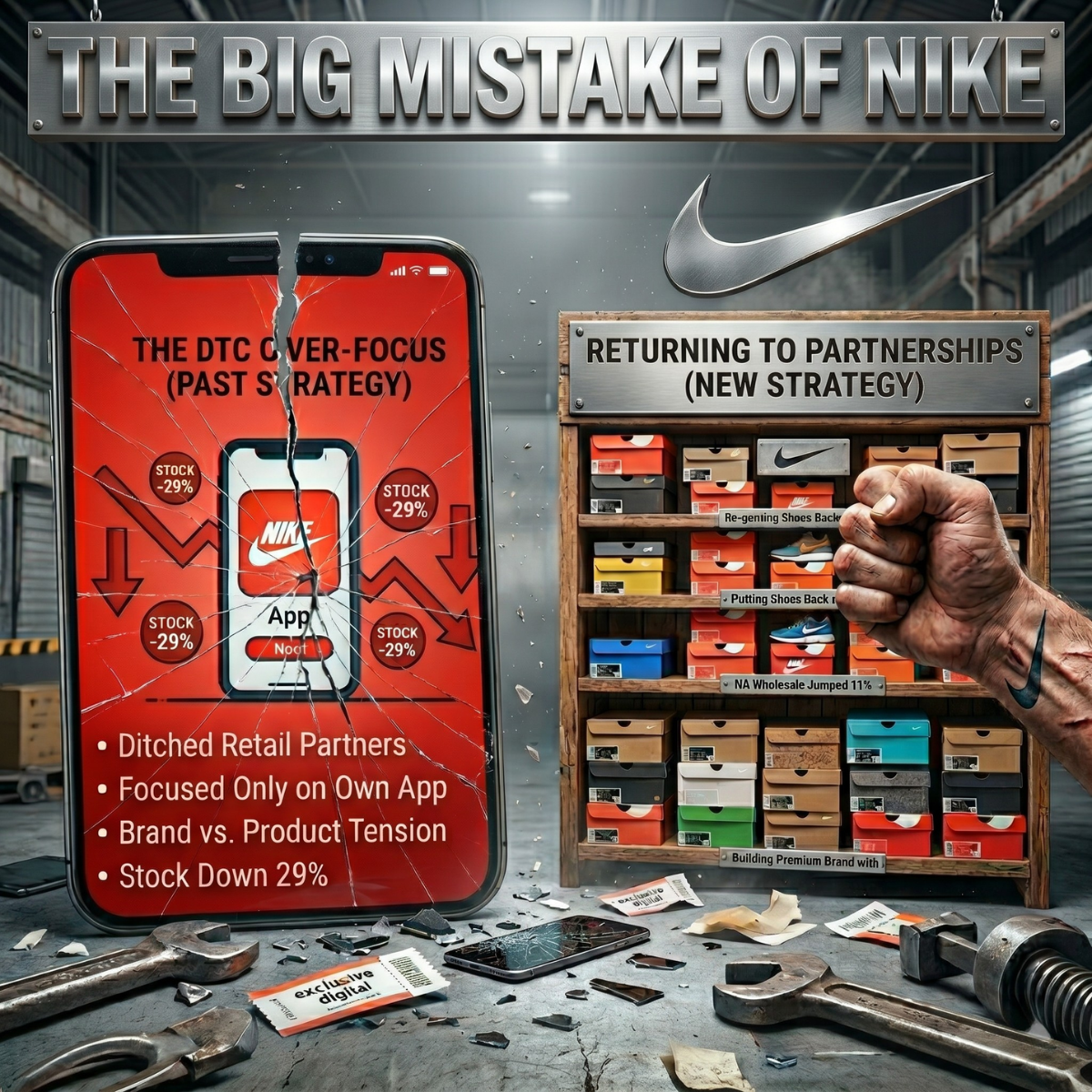
In September 2026, S&P Dow Jones Indices removed Nike from the S&P 100 index after an 18-year run. The stock fell from its late-2021 peak of $177 down to $38, wiping out more than $220 billion in market value.
Most business analysts blame one decision: Nike’s aggressive Direct-to-Consumer (DTC) push, where the company cut off wholesale partners to force shoppers onto the Nike app.
That is only half the story.
The bigger failure happened inside the product development team. Nike stopped making breakthrough athletic shoes and relied on re-releasing 40-year-old retro lifestyle models like Dunks, Air Force 1s, and Air Jordans. When competitive runners, gym-goers, and everyday walkers needed performance gear, Nike had nothing exciting to offer.
Nike did not just abandon retail shelf space. They lost the product war.
The Direct-to-Consumer (DTC) Strategy Failure: Where the Math Broke
In 2020, Nike launched its Consumer Direct Acceleration (CDA) strategy under former CEO John Donahoe. The spreadsheet logic seemed simple:
- Wholesale gross margins: ~35% to 40% after retailer cuts.
- Direct-to-consumer gross margins: 50% to 60%+.
Corporate leadership assumed that cutting out retail middlemen would instantly boost profit margins and create a direct relationship with every customer.
The Real Cost of Abandoning Retail Partners
Between 2020 and 2023, Nike terminated or slashed accounts with roughly 50 major retail partners, including regional running shops, department stores, DSW, Urban Outfitters, and even reduced allocation to Foot Locker.
That financial model broke down for three specific reasons:
- Digital acquisition costs exploded: As privacy rules made targeted online ads more expensive, getting customers to open an app cost significantly more money.
- Loss of physical foot traffic: An app only reaches people who are already looking for your brand. It does not introduce your product to a casual shopper walking through a mall.
- No physical try-on experience: Performance footwear is a tactile purchase. Runners and athletes need to feel the foam, check the arch support, and test the fit before spending $160.
Nike gained direct digital margin on paper, but they destroyed their total addressable market.
Footwear Innovation Crisis: When Retro Sneakers Replaced Real Engineering
While management focused on building digital apps and tracking user data, the actual product pipeline dried up.
Feedback
Shoe
Culture
Data
Updates
(Dunks)
Neglect
The Organizational Mistake
Historically, Nike organized its teams around specific sports: Running, Basketball, Football, and Training. Each team lived with athletes, understood biomechanics, and developed new foams and plates.
Under the direct-to-consumer restructuring, Nike reorganized into broad demographic categories:
- Men’s
- Women’s
- Kids’
This internal shift stripped away specialized sports engineering. Product teams started designing for general lifestyle trends rather than athletic performance.
The “Panda Dunk” Trap
Instead of creating the next generation of running foams, Nike flooded the market with endless color variations of retro shoes, especially the black-and-white “Panda” Dunk. For two years, this generated fast cash. But sneaker culture moves quickly.
When demand for retro shoes cooled, Nike was left with bloated warehouses, forcing heavy discounts that crushed gross margins down to 42.7%.
Athletic Footwear Market Share: How On, Hoka, and Brooks Conquered the Shelves
Retail shelf space in the performance running market is a zero-sum game. When Nike pulled its inventory out of independent running stores and multi-brand retailers, store owners did not leave those shelves empty. They filled them with hungry competitors.
What Competitors Did Right
- Hoka (Deckers Outdoor): Built maximum-cushion road and trail running shoes that captured runners, marathoners, and healthcare workers on their feet all day.
- On Running: Engineered unique CloudTec sole geometry with clean, premium design that captured both serious runners and affluent casual buyers.
- Brooks: Focused purely on consistent fit and durability for core road runners, dominating independent specialty running stores.
When regular runners walked into local running shops to get their feet scanned and tested on treadmills, Nike was absent. The sales staff recommended On and Hoka because those brands provided comfortable shoes with real technological advantages.
Consumers tried them, loved them, and never went back to Nike.
Rebuilding Wholesale Distribution: The Reality of Elliott Hill’s Turnaround
In late 2024, Nike replaced John Donahoe with Elliott Hill, a 32-year company veteran who started as an intern and understood the company’s product-first roots. Hill immediately launched a turnaround plan called the “Sport Offense,” aiming to repair wholesale partnerships and rebuild sports innovation.
However, returning to wholesale is much harder than leaving it:
- Retailers hold the leverage: Store owners signed multi-year purchase orders with Hoka, On, New Balance, and Asics. They will not drop top-selling brands just because Nike wants its old space back.
- Brand prestige takes years to rebuild: Once runners associate a brand with casual fashion rather than elite performance, convincing them to trust that brand for marathon training requires years of proven product consistency.
- Discount overhang: Excess inventory in discount channels continues to hurt full-price brand perception.
Key Lessons for Retail and FMCG Leaders: The New Omnichannel Playbook
In commercial advisory work across consumer brands and retail chains, the same strategic mistakes appear repeatedly. Here are the five direct lessons every business leader must take from Nike’s crisis:
- Wholesale is your showroom, not an expense. Retail stores provide physical discovery, immediate fit testing, and brand credibility. Treating wholesale solely as a margin drain ignores how customers actually discover and evaluate physical goods.
- DTC is for loyalty and reorders, not customer discovery. Digital channels work well for existing fans who know their exact shoe size and prefer home delivery. It is an inefficient tool for converting skeptical first-time buyers.
- Distribution cannot hide bad product. If your product is average, expanding shelf space will not save you. If your product is outdated, an app will not convince people to buy it at full price.
- Specialization beats generic demographic management. When you eliminate technical product experts to save overhead, your innovation pipeline will dry up within three years.
- Shelf space is easy to surrender, expensive to regain. Once a competitor occupies a shelf and delivers healthy sales per square foot, retailers will not give that real estate back without massive concessions.
Frequently Asked Questions (FAQ)
Why did Nike get removed from the S&P 100?
S&P Dow Jones Indices removed Nike from the S&P 100 during its September 2026 quarterly rebalance because the company’s market capitalization collapsed from roughly $280 billion to under $57 billion. The index tracks the top 100 large-cap US companies, and Nike’s prolonged valuation drop made room for faster-growing businesses.
Was the DTC strategy the only reason Nike lost market share?
No. Cutting wholesale accounts reduced customer access, but the primary cause was a lack of product innovation. Nike relied heavily on re-releasing vintage lifestyle shoes (Dunks, Air Force 1s) while competitors developed superior cushioning and performance technologies for runners and everyday athletes.
How did On Running and Hoka beat Nike in performance running?
On and Hoka focused squarely on consumer comfort, distinct cushioning technology, and local specialty running stores. When Nike pulled back from specialty wholesale accounts, these brands partnered with local shops, placed shoes directly on testing walls, and won over runners through direct physical trials.
Can Elliott Hill fix Nike’s wholesale business quickly?
No. While CEO Elliott Hill has re-engaged wholesale partners, retail shelf space is zero-sum. Retailers have already committed floor space and inventory budgets to competitors. Nike must now develop genuinely innovative performance products and offer attractive commercial terms to earn those display walls back.
Related posts:
 100 Global Cities by Quality of Life and Cost 2026
 Car Color Market Share Trends 2025: Grayscale Hits 80.4%
 Emerging Megacities: FMCG Retail Trends and Consumer Shifts by 2050
 Aldi vs Tesco Sainsbury Loyalty Schemes: 2026 Analysis
 GLP-1 Retail Market Trends 2026: Data, Forecasts & Consumer Shifts
 Spain Grocery Market Share 2026: Why Giants Flatline
Leave a Reply