
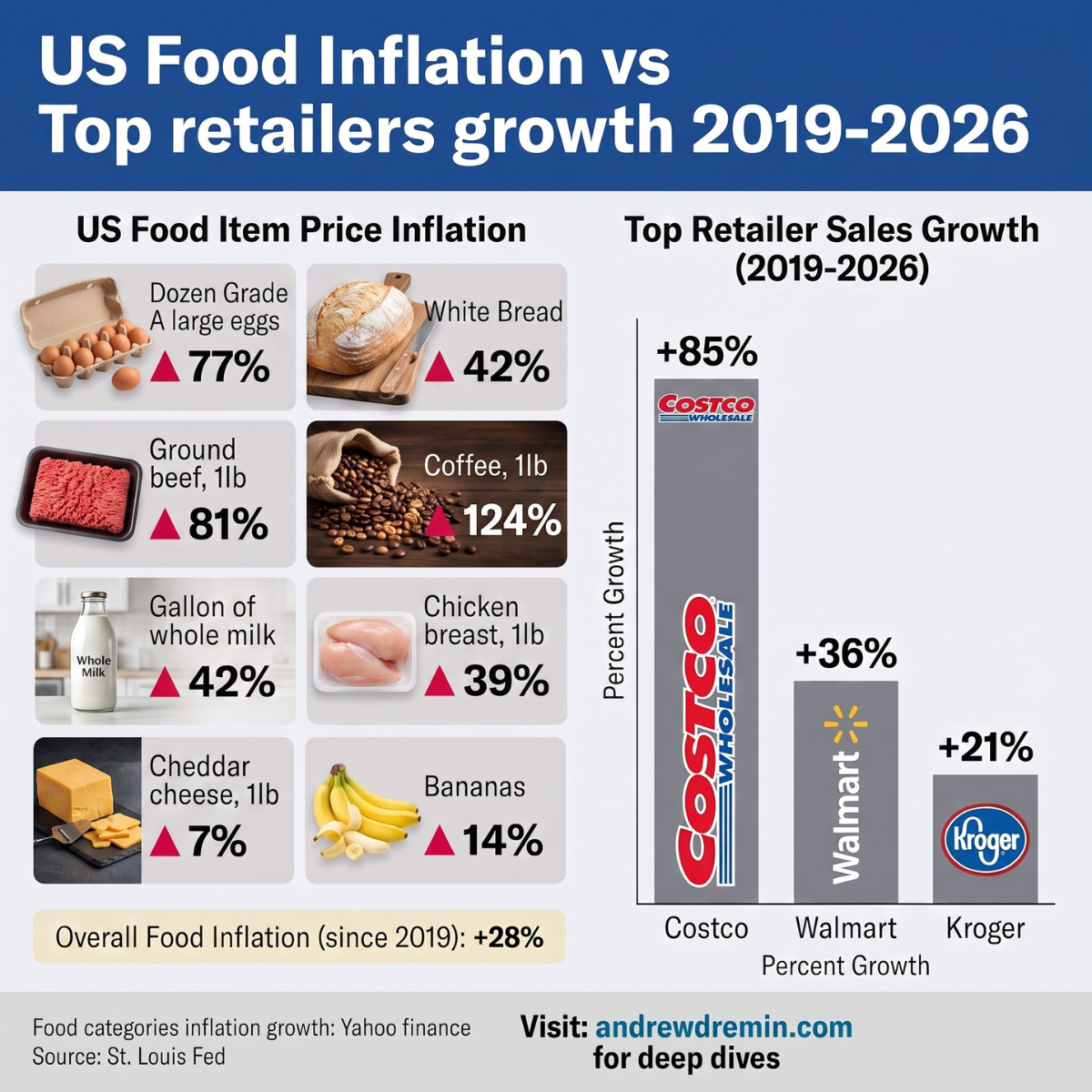
Coffee is up 124%. Ground beef is up 81%. Eggs are up 77%.
Overall US food-at-home inflation increased by roughly 28% between 2019 and 2024. During that exact same period, look at the net sales growth across major retail players:
- Costco Wholesale: +85%
- Walmart US: +36%
- Kroger: +21%
If cumulative grocery inflation is 28% and your supermarket sales only grew 21%, your business did not grow. It shrank. You took in more paper dollars at the cash register, but you moved fewer boxes, cans, and pounds of food through the loading dock. You lost real unit volume, shelf tonnage, and shopper trips.
High inflation handed retail executives record top-line revenue numbers. But top-line revenue masked an operational problem: physical unit decline.
People did not stop eating. Instead, shoppers changed how and where they spend:
- Higher-income households shifted toward wholesale clubs to lock in lower unit prices on bulk groceries.
- Middle- and lower-income families traded down to hard discounters, bought store brands, or dropped non-essential items from their baskets.
- Traditional grocers absorbed the hit because they acted as passive cost-pass-through machines for large consumer goods manufacturers.
The Inflation Illusion in US Grocery Retail
When prices climb 25% to 30%, top-line revenue becomes an unreliable metric.
Real Growth Formula:
Dollar Sales Growth (%) – Price Inflation (%) = Real Volume Growth (%)
If a store generated $100 million in 2019 and $121 million in 2024, it looks like a $21 million win on paper. But with 28% food inflation, that store needed $128 million just to match its 2019 unit volume. A $121 million result means a net 5.5% drop in physical goods moved.
Why Unit Volume Drop Damages Supermarkets
- Fixed Operating Costs Remain Constant: Electricity for refrigerated display cases, truck routes, and store labor do not drop just because you sold 10% fewer soup cans.
- Loss of Supplier Scale: Lower unit velocity weakens your bargaining leverage with suppliers for future purchasing contracts.
- Margin Dilution: When foot traffic falls, high-margin impulse purchases (bakery, deli, floral) drop faster than staple items.
Competitor Breakdown: Winners and Losers in the Grocery Price War
The retail market has split into clear winners and losers based on how each company handled pricing, private labels, and packaging.
| Retailer | Sales Trend (2019–2024) | Primary Driver | Vulnerability |
| Costco Wholesale | +85% | Bulk unit pricing; high-income member loyalty | High entry price point per visit |
| Walmart | +36% | Massive private label; supply chain leverage | Customer service and store experience |
| Aldi | High Double-Digit Store Expansion | 90%+ private label; low operating costs | Limited national brand selection |
| Kroger | +21% | Strong loyalty data; personalized digital promotions | Caught between discounters and premium grocers |
| Dollar General | Stalled Same-Store Units | Small pack sizes for cash-strapped shoppers | Higher unit price ($ per ounce) |
Costco: The Unit Price Leader
Costco captured market share from conventional supermarkets by catering to households making over $100,000. These shoppers have the cash flow to spend $300 per trip to get a lower cost per ounce on pantry staples, meat, and paper products.
Walmart: The Safe Harbor for Stretched Budgets
Walmart used its size to force suppliers to justify every price hike. By keeping price gaps wide against traditional grocers and expanding its Great Value line, Walmart attracted millions of middle-income shoppers who previously bought at standard regional supermarkets.
Aldi: The Structural Cost Advantage
Aldi operates with smaller stores, minimal staff, and 90% exclusive private-label products. They do not carry 40 varieties of olive oil; they carry two. This simplicity keeps overhead low, allowing them to undercut conventional supermarkets by 15% to 30% on basic basket essentials.
Traditional Grocers (Kroger, Albertsons, Regional Chains): The Squeezed Middle
Conventional grocers accepted price hikes from large food manufacturers and passed them directly to shelf tags. As a result, they trained their own customers to shop elsewhere for staples, leaving them dependent on weekly circulars and promotional discounts just to maintain baseline traffic.
Dollar Stores (Dollar General, Family Dollar): The Unit Price Trap
Dollar stores offer low absolute price points ($1 to $5 items), but the cost per unit of measure is often higher than at Walmart or Aldi. As extreme inflation squeezed their low-income core customers, those shoppers trimmed overall basket counts or consolidated their shopping trips at supercenters.
What US Grocery Retail Trends 2026 Mean for Supermarkets
Tracking revenue without tracking units creates dangerous operational blind spots.
- Dead Space Allocation: A branded cereal with a price increase from $3.50 to $5.50 might show stable revenue while selling 30% fewer boxes. That product occupies four feet of prime shelf space while gathering dust.
- False Margin Assumptions: High gross margin percentages on slow-moving items do not pay the bills. Cash comes from cash margin multiplied by unit velocity.
- Distorted Demand Forecasting: When automated inventory algorithms look only at dollar targets, they under-order physical inventory during price drops and over-order expensive, slow-moving items.
5 Practical Steps to Recover Lost Unit Volume
Retailers and FMCG brands need to stop relying on inflation-driven revenue and start fixing their physical unit flow.
1. Audit Every SKU by Unit Velocity, Not Dollar Revenue
Group your product assortment into a 2×2 matrix comparing Unit Velocity against Dollar Margin Contribution.
- High Units, High Margin: Core drivers. Protect shelf space and maintain inventory levels.
- High Units, Low Margin: Traffic drivers (milk, eggs, bananas). Price competitively to defend store traffic.
- Low Units, High Margin: Niche and specialty items. Keep a tight, curated selection.
- Low Units, Low Margin: Dead weight. Products masking sales drops behind 30% price jumps belong here. Eliminate them immediately.
2. Fix Price-Pack Architecture (PPA)
Flat price hikes across an entire brand portfolio do not work. You need a two-front packaging strategy:
- Entry-Level Packs: Introduce smaller sizes at critical price thresholds (e.g., keeping a daily snack under $2.00 or $3.00) to keep budget-conscious shoppers from leaving the category.
- Family Value Packs: Offer larger, bulk packs with an explicit “cost per ounce” advantage to compete directly with club stores.
3. Build a True Opening-Price-Point (OPP) Private Label
Do not confuse premium private labels with entry-level store brands.
Tier 1: Premium Private Label (Matches or exceeds national brand quality)
Tier 2: Core Store Brand (Standard quality at 15-20% lower price)
Tier 3: Opening Price Point / OPP (Unbeatable entry price for basic survival basket)
If your supermarket does not offer an entry-level OPP option for flour, cooking oil, rice, and canned vegetables, price-sensitive shoppers will split their basket and buy those staples at Aldi or Walmart.
4. Stop Automatic Cost Pass-Throughs
When agricultural commodities, freight rates, and packaging materials cool down, renegotiate vendor contracts.
- Require suppliers to provide transparent commodity cost breakdowns.
- Adjust shelf retail prices downward on key value items (KVIs) to signal value to shoppers before competitors do.
- If a manufacturer refuses to cooperate on cooling input costs, reduce their facings and give that shelf space to dynamic pricing strategies with your private label.
5. Shift From Broad Promotions to Targeted Loyalty Pricing
Running 20% off sales across an entire aisle wastes margin on shoppers who would buy anyway. Use loyalty program data to deliver personalized discounts on the specific items an individual shopper has stopped buying.
Frequently Asked Questions (FAQ)
Why is unit volume a more reliable retail metric than dollar sales?
Dollar sales are distorted by inflation. If prices increase by 20% and sales increase by 10%, the business is moving roughly 10% fewer goods. Unit volume measures the actual quantity of products customers take home, reflecting real customer demand, store traffic, and inventory efficiency.
How did Costco grow 85% while standard supermarkets struggled?
Costco sells groceries in bulk at a low gross margin (typically capped around 11% to 15%), giving customers an unbeatable price per pound or ounce. Their membership fee model allows them to prioritize high unit volume over high item markups, which attracted inflation-weary middle- and high-income shoppers.
What is the difference between Opening Price Point (OPP) and standard private label?
A standard private label offers national-brand quality at a 15% to 20% discount. An Opening Price Point (OPP) brand is designed strictly to be the lowest-priced item on the shelf in that category. It acts as a safety net to prevent price-sensitive shoppers from leaving your store for hard discounters.
How does shrinkflation hurt grocery retailers in the long run?
Shrinkflation (reducing package size while keeping the price the same) damages customer trust. Once shoppers realize they are paying the same amount for less product, they actively search for alternatives, leading to category abandonment, brand switching, or migration to bulk retailers.
What should category managers do when commodity prices fall?
Category managers must review supplier cost sheets and demand lower wholesale costs when inputs (such as corn, wheat, resin, or diesel) decline. Reducing shelf prices on key staple items quickly helps a retailer rebuild unit velocity and regain market share ahead of slower-moving competitors.
Are you tracking real units on your shelves, or is top-line inflation still hiding your volume decline?
Related posts:
 UK Grocery Loyalty Trends 2026: Why the Lidl Plus Points Backlash Matters
 Tesco and Football championship
 Spain’s retail deadline
 Poland’s Growth Engine is a Margin Trap
 Europe Grocery Retail Consolidation 2026: REWE & Carrefour
 Spain Supermarket Food Service Trends 2026: Why Mercadona is Beating McDonald’s
Leave a Reply